
August 17, 2026 • 4 min reading
By Indrabati Sarkar, Lead - Brand Voice & Content (Consultant)
Ever since the announcement of Generative AI becoming available to the public, there have been predictions about the advent of AI shall change the world as we know it. Now, with AI moving into the workplace, the labour market is feeling the consequences. McKinsey estimates that up to 30% of hours worked across the US economy could be automated by 2030, with around 12 million occupational transitions required by the same year.
While this may sound alarming, this is only half the story. The World Economic Forum has estimated that while technology could displace 85 million jobs globally, it could also create 97 million new ones and that needs to be the next conversation.
Large corporations and Fortune 500 companies show near-universal adoption (up to 99% in top-tier indexes) of AI and companies are deploying the technology across operations, customer service, manufacturing, healthcare and field service.
The digital transformation has now moved from being experimental to an integral part of business processes. Which is creating a demand for people who can install them, integrate them with existing systems, monitor their performance, manage their data, audit and troubleshoot when something goes wrong. They are called AI technicians.
The role of an AI technician is that of a bridge between the AI systems companies are deploying and the environments it is being deployed in. To know more about how AI systems understand real work situations, you may read our blog here.
An AI technician is responsible for the practical side of AI.
The work can include:
Installing and configuring AI systems
Integrating AI into existing enterprise systems
Testing and debugging AI applications
Monitoring AI performance
Managing and analysing data
Troubleshooting system failures
Optimising AI systems for performance
Working alongside data scientists, engineers and business teams
With Artificial Intelligence being deployed across factories, hospitals, warehouses and field operations, the job becomes more complicated and thus calls for a deeper human-machine collaboration.
AI will change the composition of technical work.
Routine technical tasks shrink: repetitive monitoring, basic diagnostics, documentation and information retrieval increasingly move to AI systems.
Technical roles become more specialised: AI, data, computer vision and systems integration become part of industrial job profiles.
Skills have to keep evolving: technicians and technical teams will need to understand how AI systems behave, interpret their outputs and work with increasingly intelligent equipment.
Human oversight becomes part of the job: people will need to monitor AI performance, identify errors and intervene when systems encounter situations they cannot handle.
AI becomes part of the infrastructure: as companies deploy AI across operations, maintaining the systems becomes an ongoing operational requirement, much like maintaining other critical technology today.
This is where AI technicians become particularly important for frontline industries as they will be responsible for ensuring that the AI systems are functioning optimally and properly integrated into the environments where people use them.
Boston Consulting Group in their 2026 study estimates that 50% to 55% of US jobs could be reshaped by AI over the next two to three years. Its analysis also suggests that 23% of jobs will become "enabled" roles, where AI becomes part of everyday work while core responsibilities remain human-led.
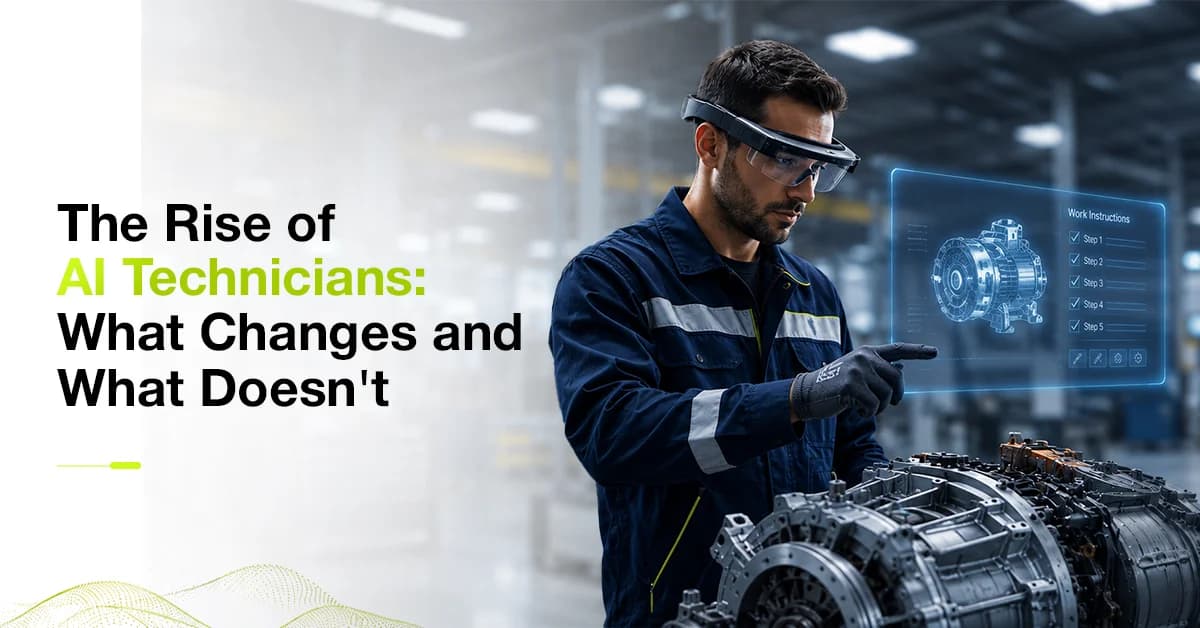
Physical work shall still need people: Machines still need to be inspected, repaired, assembled and maintained. AI can guide a technician through a repair, but it cannot replace the person handling the equipment.
Complex judgement shall remain with humans: Frontlines are dynamic environments where every fault looks different. Technicians use their experience to interpret several small signals, assess the condition of equipment and decide what needs to happen next.
Safety and accountability remain human responsibilities: In environments where a wrong decision can damage equipment or put people at risk, someone still has to take responsibility for the action.
Experience remains valuable: Years of working with machinery give technicians an understanding of sounds, vibrations, recurring faults and unusual behaviour that may not exist in structured datasets.
AI is only for assistance: AI can recommend a diagnosis or a course of action. A skilled technician needs to recognise when the recommendation doesn't fit what they are seeing on the ground.
The IBM Institute for Business Value has found that organisations deploying AI at an operational level outperformed their peers by 44% on critical measures including employee retention and revenue growth. So for businesses, the next big question has now moved beyond adoption of AI.
It has become more interesting and action-led - What are you doing to accelerate this inevitable digital transformation and build the technical workforce capable of making these systems work at scale?
This is where UnfoldXR becomes part of the changing frontline workplace. With AVA, its Agentic AI layer, UnfoldXR brings enterprise knowledge, equipment information, guided workflows, AR and AI-assisted diagnostics into the technician's workflow. UnfoldXR replaces multiple, fragmented frontline tools with one unified platform assisting technicians at every step of a task. From smart planning, to fast diagnosis, error-free execution and instant reporting one continuous flow with AI & AR-powered proficiency.
To know more about our AI-AR powered Saas platform for frontline productivity, visit our website www.unfoldxr.com or write to us at info@unfoldxr.com.