
August 10, 2026 • 5 min reading
By Indrabati Sarkar, Lead - Brand Voice & Content (Consultant)
Most of us do not have a very clear idea about how a machine, aka AI learns to see and identify objects, surroundings and environments. We might know about ‘model training’ and ‘computer vision’ which have become everyday terms but what we understand of it is probably something like this -
Show the AI enough photographs of an object and eventually it will recognise that. That assumption works well for identifying a traffic signal, a chair, or a cat in a photograph. However, a dynamic and complicated factory floor is a very different challenge.
On a manufacturing floor machines looking almost identical can be performing very different jobs. In a real world scenario, a lot more is dynamic than in a training sequence. For example, lighting changes across shifts, equipment gets upgraded, new production lines are added and a human technician doesn't identify all this by appearance alone. They recognise its location, the warning signs around it, the sounds it makes, the equipment beside it, through years of accumulated experience and spatial understanding.
For an AI functioning in the frontline, the learning of a factory floor is more similar to a human process than we can imagine.
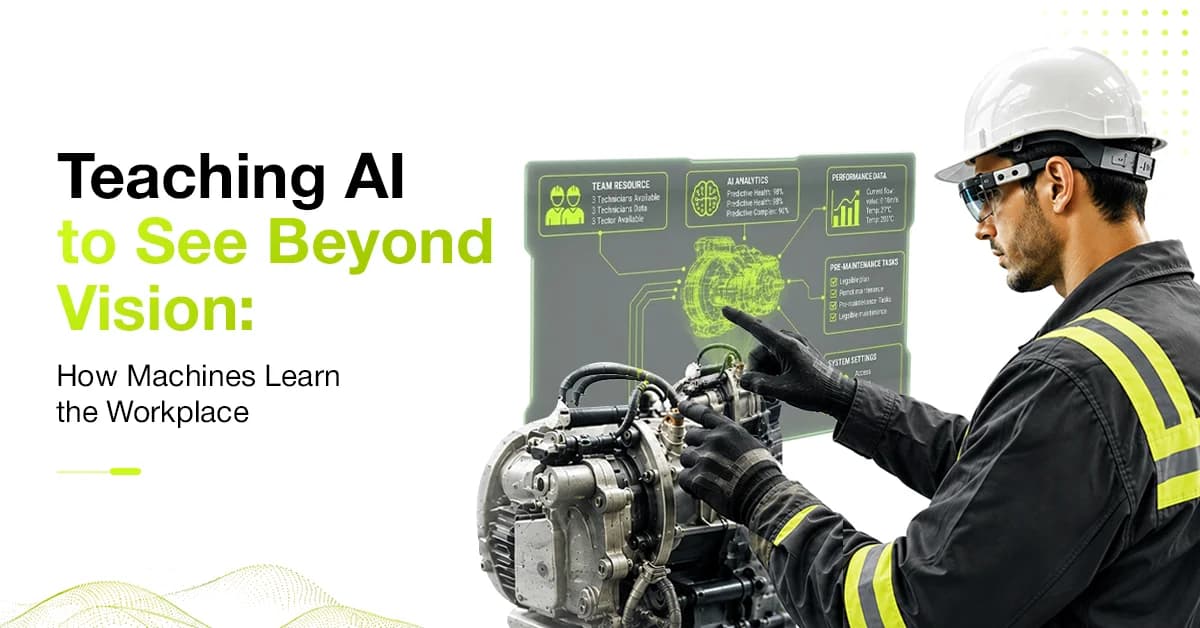
Think of an expert technician walking through a factory. They don’t only identify a machine |but also understand where it fits within the larger operation. He recognises a machine, its parts, the function it plays, the maintenance it requires and so on. None of these observations exist in isolation. Together, they create a mental map of the workplace.
For an Enterprise AI to assist a worker effectively, it has to build the same understanding which comes from combining several layers of information.
The physical layout of the facility
The identity of every asset
Relationships between machines
Operating procedures
Maintenance history
Enterprise data
The work already performed on that equipment.
This information is the difference between recognising an object and understanding a workplace. It is also what separates a general computer vision model from an enterprise AI platform built for frontline work.
Much like how a human being uses multiple sensory organs and reasoning to understand an object and the relation it has with the space it occupies, UnfoldXR uses several technologies together to train an AI to understand and recognise a factory floor, or any frontline work scenario.
Using photographs and videos, the platform creates a detailed digital understanding of the workplace. Instead of remembering individual images, the system develops a spatial representation of the environment, allowing it to recognise spaces and equipment even when connectivity is limited.
Critical assets are mapped with visual markers linked to pre-configured information. The moment a worker scans a machine, the platform knows exactly which asset it is looking at and retrieves the relevant information with high accuracy. Since this information is already mapped, it continues to work offline.
Multiple computer vision models work together, contributing a different layer of understanding.
YOLO (You Only Look Once) rapidly detects and identifies machinery, tools, components, caution plates, labels, and other objects within the worker's field of view. At the same time, SAM (Segment Anything Model) separates and maps individual objects within the scene, allowing the platform to distinguish one machine, component, or part from another with far greater precision.
Together, these models help the platform identify an asset by adding another layer of confidence as the objective is not simply to recognise a machine but to recognise the right machine, understand where it is, what surrounds it, and connect it to the operational knowledge needed to complete the task.
Knowing what a worker is looking at solves only one part of the problem. Enterprise AI Agents are here to answer the next level of question - What should the worker do now?
At this stage, operational knowledge becomes critical and here, the platform connects what it sees with information already available across the organisation.
Standard operating procedures
Previous maintenance records
IoT sensor data
Digital twins
Equipment history
Service reports
Enterprise systems
With the AI collating all these information from various sources, the worker is saved the time taking ordeal of opening multiple applications, searching through documents or calling experienced engineers. Instead, they receive information that is directly relevant to the task in front of them.
It recommends the next step, retrieves the right documentation, supports troubleshooting, and even provides AI-assisted insights to remote experts joining a live session. UnfoldXR's Agentic AI, AVA reasons across all the inputs, visual and documents, to provide contextual guidance for faster decision making and smoother execution.
While humans bring in the experience, machines bring precision which enables better decisions and faster outcomes. The impact extends across almost every frontline operation.
According to Boston Consulting Group reports, ‘a breakthrough 74% of frontline employees are now regular AI users. Of frontline workers, the 42% who are regular AI users report saving a workday each week. And more than two-thirds of all employees of all types say AI has taken over simpler tasks, leaving them with more complex work.’ This is happening as workers spend less time searching for information, experts can support multiple sites without travelling, new technicians gain access to years of accumulated organisational knowledge and workers can perform tasks with higher confidence.
At UnfoldXR, we aim to enable 1 million frontline workers to perform better by 2030 and that can be achieved only when AI and humans work as teammates. And for AI to truly assist higher performance, machines have to understand the workplaces they are working in.
To know how we can help you with your AI transformation strategy speak to an UnfoldXR expert today. You may visit www.unfoldxr.com or write to us at info@unfoldxr.com.