
September 09, 2026 • 2 min reading
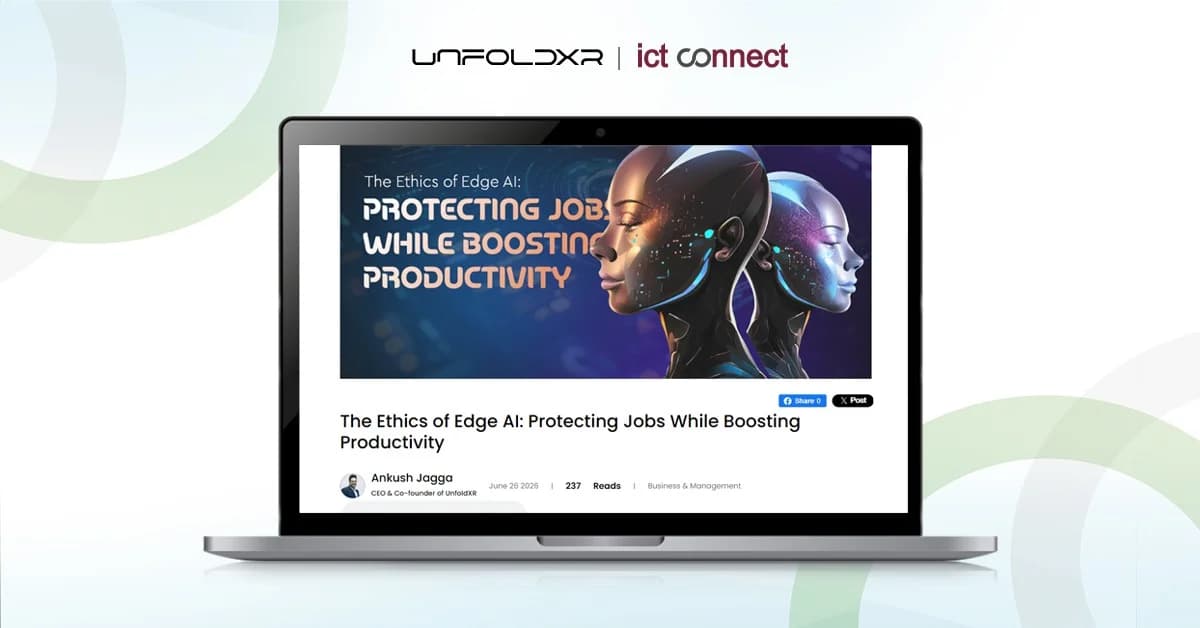
Noida, India — September 9, 2026 — As artificial intelligence moves from back-office systems into the flow of frontline work, the conversation around productivity is increasingly being shaped by a more fundamental question: how can organisations use AI to strengthen human capability while preserving workforce trust? In a recent feature published by ICT Academy on June 26, 2026, Ankush Jagga, CEO and Co-founder of UnfoldXR explores this question in “The Ethics of Edge AI: Protecting Jobs While Boosting Productivity.”
The article examines how Edge AI, generative AI, and agentic systems are changing the way intelligence reaches workers. As these technologies become more embedded in manufacturing floors, warehouses, maintenance sites, and field operations, their value extends beyond faster decisions. They can help workers access guidance in real time, reduce unnecessary searching and escalation, and make critical expertise available where it is needed most.
For UnfoldXR, this is closely connected to a broader vision of making AI-powered productivity tools accessible to the world’s deskless workforce. The feature highlights the importance of treating AI as a skill multiplier—one that helps workers learn while they work, supports faster decision-making, and extends the knowledge of experienced employees across the organisation.
“The real question today is not whether AI will enter frontline work, because it already has. The real question is: How can we use AI to not replace workers, but make them more capable?”
— Ankush Jagga, CEO & Co-founder, UnfoldXR.
The article also addresses the importance of trust in frontline AI adoption. Workers are more likely to embrace intelligent systems when they understand their purpose, see how they reduce effort, and retain the ability to question or override recommendations when necessary. For organisations, this means that ethical AI design must go hand in hand with transparency, accountability, data privacy, and human oversight.
Ankush Jagga’s perspective also highlights the responsibility of leadership in this transition. As organisations invest in AI, they must invest in the people who use it through reskilling, continuous learning, clear communication, and change management. The goal is not simply to automate tasks, but to build a workforce that is more capable, confident, and prepared for increasingly complex operational environments.
The feature reinforces an important direction for the industry: the next productivity leap will come not from replacing human expertise, but from making it more accessible, actionable, and scalable. By bringing intelligence closer to the worker and keeping human judgement at the centre, organisations can create a more practical and sustainable path to AI adoption.
UnfoldXR is focused on bringing AI-powered productivity tools to the world’s 2.8 billion deskless workers. The company’s vision is to make frontline work more efficient, accessible, and knowledge-driven by helping workers access the right information, guidance, and support when and where they need it.