
August 26, 2026 • 5 min reading
By Indrabati Sarkar, Lead - Brand Voice & Content (Consultant)
This is the era of Industry 4.0 and the average First-time-fix-rates across industry is still 75% which means 1 out of every 4 repair work needs a revisit. At this age and time, that is just not good enough which requires industry leaders to think beyond SOPs, digital or otherwise. It is time for Smart Guidance.
Throughout the modern history of industrial production, SOPs have been intrinsic to the process of scaling across multiple facilities. Consistency has been the key for industries to avoid a missed step that can damage equipment, compromise quality or create a safety risk. These exhaustive documents have helped organisations standardise processes, train workers and share critical information.
But SOPs are after all what they stand for - Standard Operating Procedures. While it may serve the purpose in a ‘standard’ situation, it falls short when an employee faces an unforeseen challenge.
Knowing about a procedure is not enough for a technician responding to an unexpected machine failure. They may also need to know the maintenance history of that particular asset, the last repair performed, the parts replaced, recent inspection observations and whether similar faults have appeared before. This critical information is usually spread across multiple systems and documents like a CMMS, an ERP, equipment manuals, service reports and even in the memory of a technician maintaining the asset for years.
Therefore, SOP is only one part of industrial knowledge that is required to achieve the agility that the current global standards demand.
Manufacturing industry has no dearth of information. For decades they have been generating data across production systems, recording work orders on maintenance platforms, collecting inspection documents, manuals and other documents which are digitised but rarely accessed. The experience accumulated by workers are lost in informal knowledge transfer.
A senior technician may know that a particular machine behaves differently during humid weather, or that a recurring vibration usually points to a problem long before the system raises an alarm. That knowledge and decades of contextual problem-solving can be difficult to write into a standard procedure because it is built through observation and repetition.
And even if there are SOPs and information available, a worker standing in front of a machine looking for relevant information while searching through five systems and hundreds of pages is hours of productivity loss. According to McKinsey & Company, employees spend an average of 1.8 hours every day gathering and searching for information. Read more about it here.
To save these critical hours for each employee, the future of industrial knowledge depends on how it is being connected to the physical environment of a factory floor where actual work happens. And for that industries shall need more than digital SOPs and work data to be stored.
There is a structure to how industrial knowledge management is beginning to change.
With digitization came the first stage of search where workers opened manuals, browsed folders or entered keywords into enterprise systems, hoping to find the right information.
This stage was followed by ask. Instead of knowing exactly where information was stored, workers could ask a digital system or AI assistant for an answer.
We are now at the next stage where the system not only helps you to search, or answers your query but proactively assists.
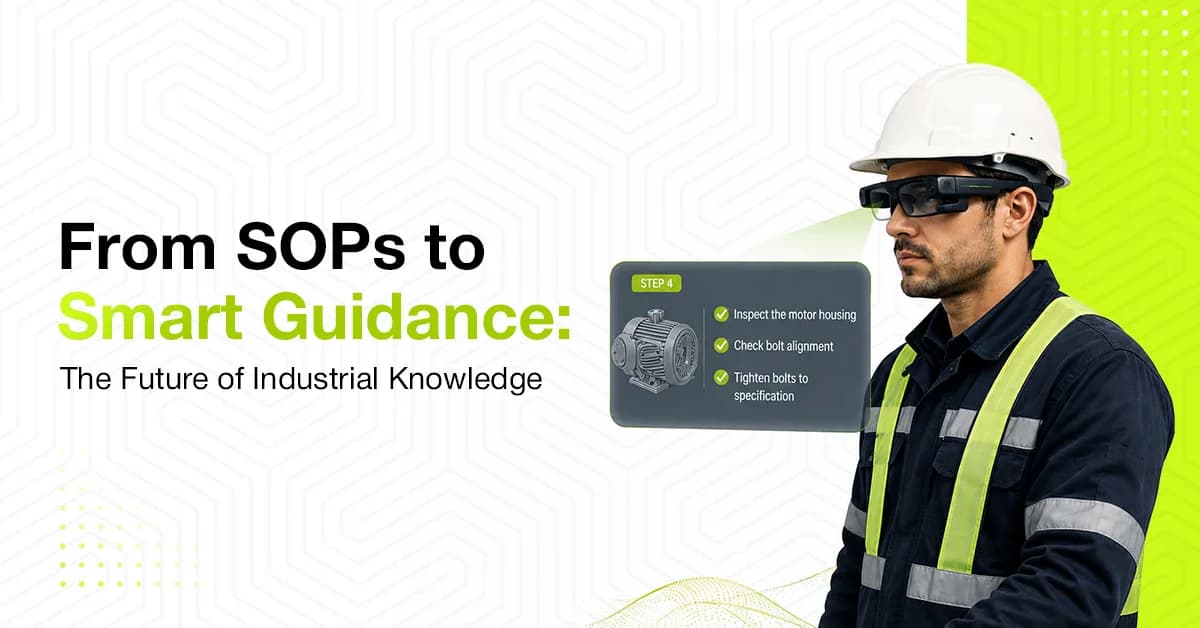
With UnfoldXR’s Agentic AI, AVA providing smart guidance, information is not only retrieved but brought into the flow of work itself. AVA identifies an asset, understands the task being performed, and retrieves relevant knowledge to guide the worker through every step of a task - before, during and after.
In dynamic industrial environments, where the same procedure does not always apply in exactly the same way, getting contextual guidance based on an asset’s condition, maintenance history, inspection reports reduces repeat work significantly.
According to Panopto Workplace Knowledge and Productivity Report 2026 the average large organization loses $47 million in productivity annually due to inefficient knowledge sharing.
This is where UnfoldXR's Creator Mode and Intelligent Mode add another dimension to industrial knowledge.
Creator Mode allows organisations to turn their own operational knowledge into guided digital experiences. Procedures, instructions and expertise that may otherwise remain inside documents or with individual employees can be structured for frontline use.
Additionally, Intelligent Mode becomes important in the ever-changing industrial environment. A technician can scan an asset and allow the platform to identify the equipment and retrieve relevant information associated with it. Maintenance history, available procedures, documentation and enterprise knowledge can become part of the task without the worker having to manually search across multiple systems.
With UnfoldXR knowledge creation or documentation is no longer a separate process but becomes a part of the job itself.
When knowledge moves from documents and databases into smart guidance at the point of work, the impact can be felt across the operation.
Faster training cycles: Smart guidance allows new technicians to learn while performing the task, with step-by-step instructions, visual guidance and relevant information available during execution.
Less time spent searching: Instead of moving between manuals, CMMS platforms, enterprise systems and documentation, workers can access the information relevant to the asset and task in front of them.
Fewer avoidable errors: Smart guidance brings the right procedure, inspection criteria and task-specific instructions into the workflow, helping technicians follow critical steps more consistently.
Faster problem resolution: When a task does not go as planned, workers can move beyond a fixed SOP and access equipment history, additional knowledge, AI-assisted support or remote expertise.
Better use of experienced workers: Routine questions do not always need to travel up the chain. Their knowledge can be captured and converted into guidance that is available across shifts, sites and teams.
Knowledge that grows with every task: Observations, repairs and outcomes captured during work can add to the organisation's growing body of operational knowledge.
For organisations operating across multiple plants, this also means that knowledge developed in one location can be scaled across sites.
Bringing the idea of smart guidance to frontline operations, through Creator Mode, Intelligent Mode, AR-guided workflows and AVA, its Agentic AI layer, UnfoldXR helps organisations turn SOPs, enterprise data and human expertise into guidance that can support workers during the task itself.
To know more about how UnfoldXR is helping industries move from static documentation to smarter, more accessible guidance for frontline workers, visit www.unfoldxr.com or write to info@unfoldxr.com.