
September 17, 2026 • 4 min reading
By Indrabati Sarkar, Lead - Brand Voice & Content (Consultant)
Automotive has some of the highest quality controls across industries. Throughout the manufacturing cycle of a vehicle, there are a series of processes and inspections performed to ensure that the vehicles meet predetermined quality standards. Various aspects such as component inspection, defect detection, and assembly verification are few of the standard quality checks which are critical to identify defects that could create safety and performance issues.
With increasing sophistication and complexity in vehicle models, the inspection process has to account for more variables while maintaining consistency across every vehicle. While these inspection and quality control processes means that there is a large amount of actionable data, it does not always reach the right people to help them make quality decisions.
As mentioned earlier, multiple vehicle models and variants means a greater challenge of consistency which increases as certain parts of checks are done by visual assessment only with records being maintained across different systems. The heavy reliance on human inspectors also increases the risk of human error, fatigue and lapse of judgement as the volume increases. Multiple inspectors creates inconsistency but with increase in volume it is inevitable, as is the possibility of losing valuable time in rechecks and misses.
In this traditional approach to quality control, a defect may get recorded for one particular vehicle. However, the larger opportunity lies in understanding whether the same issue is appearing repeatedly across a production line, shift or vehicle variant. But paper-based or disconnected inspection processes make it harder to understand whether a defect is recurrent or an outlier. When information remains tied to individual checks or fragmented systems, the organisation misses the opportunity to connect this intelligence to the larger quality picture.
This is where the industry requirement is moving towards Artificial Intelligence for defect detection, classification and trend analysis, alongside integration with MES and QMS platforms. The greater need is to enable the human inspectors with the right tools and information during the inspection process.
The very first step is to provide the human inspectors the right information for the vehicle in front of them.
An inspection workflow can identify the vehicle or component and bring up the relevant specifications, tolerance limits and acceptance criteria for that particular model or variant.
For example:
● Scan the vehicle or component.
● Load the relevant inspection workflow.
● Display model-specific acceptance criteria.
● Guide the inspector through each checkpoint.
● Record the result against the relevant vehicle.
This becomes particularly useful when the same production line handles multiple variants with different inspection requirements.
Computer vision and AI can add another layer to the inspection process. The system can analyse images captured during inspection and support the identification and classification of visual deviations.
This may include:
● Gap and flush measurements
● Surface and appearance defects
● Component identification
● Variant verification
● Deviations from defined specifications
AI and ML systems can also learn from new defect patterns and improve their performance over time. The requirement for adaptive learning and continuous improvement is becoming increasingly relevant as manufacturers introduce new models and configurations.
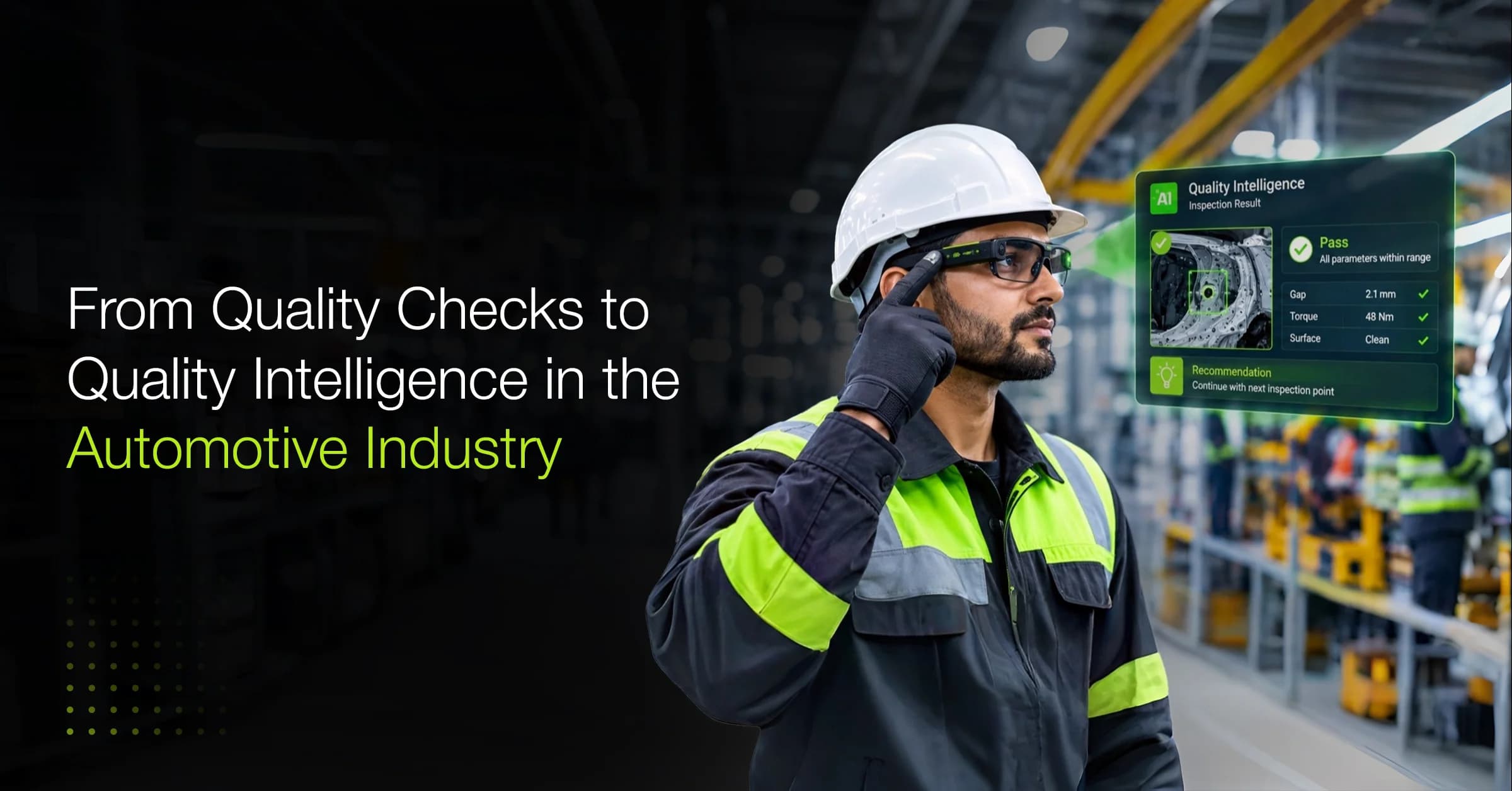
With AR, tolerance bands, inspection instructions and identified deviations can be displayed directly on the vehicle or component. The inspector can see what needs to be checked without repeatedly moving between the vehicle, the checklist and documentation.
With smart glasses, this experience becomes hands-free, while tablets and other devices can support the same workflow where required. Implementation of augmented reality connects the process of inspection to the physical vehicle.
Every inspection also creates an important record for quality teams to be used in future. Images, measurements, inspection results and timestamps can be captured as the inspection happens and linked to the relevant vehicle or component. This creates traceability while reducing the need to recreate documentation after the work is complete.
The same approach can support compliance requirements and provide quality teams with a more complete record of what was inspected, what was found and what action followed.
Once inspection information is consistently captured, it can be consolidated across vehicles, shifts and production lines.
Quality teams can then look for:
● Recurring defects
● Trends across shifts
● Model-specific deviations
● Repeated inspection failures
● Changes in defect frequency
UnfoldXR brings AI, computer vision, AR, guided workflows and evidence capture into a connected frontline inspection experience. Its agentic AI, AVA provides model-specific instructions to the inspector, assists in identification and captures inspection evidence while the work is being performed.
This results in creating a quality process that solves various challenges of the automotive industry. With UnfoldXR, information from multiple sources are brought together to ensure the highest levels of quality check by providing relevant information and guidance to the inspector with greater speed and context. For automotive manufacturers, that creates an opportunity to use every inspection as more than a checkpoint but a standard that translates into business impact.
To know more about UnfoldXR’s role in enhancing the performance of quality inspectors at the frontline in the automotive industry visit www.unfoldxr.com or write to us at info@unfoldxr.com.