
October 22, 2026 • 4 min reading
By UnfoldXR, By Indrabati Sarkar, Lead - Brand Voice & Content (Consultant)
With smart glasses and AR headsets becoming popular even in workplaces, a familiar problem is emerging. Even with access to digital instructions, equipment data and AI assistance, workers are still having to stop their work midway to reach for a screen or navigate a series of menus to interact with the information.
According to McKinsey, up to 30% of technicians’ time is spent searching for information. This means that while a lot of information might be available at a worker’s disposal, it does not necessarily guarantee the worker's ability to use it at the right moment.
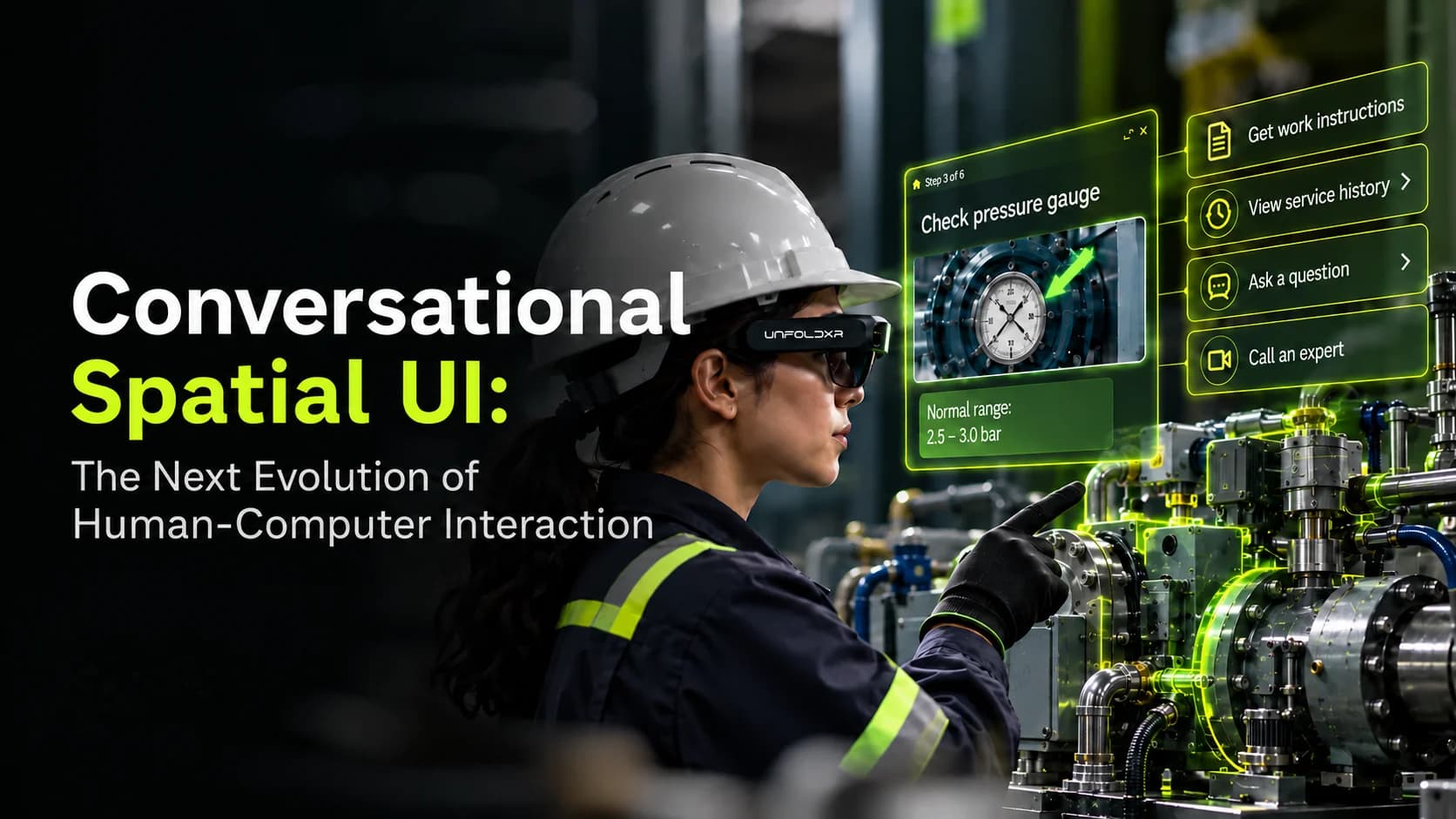
Conversational spatial UI offers a way to solve this challenge by combining voice commands, computer vision, gestures and AI. It helps people to interact with digital systems as the interface becomes responsive to what the worker is doing, what they are looking at and what they need to accomplish.
For decades, human-computer interaction has been defined by clicks, keyboards, mice, touchscreens and handheld controllers. In conventional computing environments, or desk jobs, these interfaces work but it does not help deskless workers performing critical tasks at the frontline.
In frontline environments, even a simple need to check an information can interrupt a workflow. A technician may need to remove a glove to operate a screen, scroll through a manual or switch between an inspection checklist and equipment records.
Conversational spatial UI introduces a different way to interact. Workers can use natural language to request information or initiate actions while keeping their attention on the task. Research by Deloitte shows that these kinds of workflows reduce task time by 30–50%.
Its potential advantages include:
● Hands-free access: Workers can request instructions and information without reaching for another device.
● Faster navigation: Voice commands reduce the need to move through menus and screens.
● Contextual assistance: AI can connect a request to the equipment, procedure or task at hand.
● Multimodal interaction: Voice, vision, gaze and gestures can work together to interpret intent.
● In-workflow actions: Workers can record observations, retrieve specifications or request expert support without leaving the task.
An Intelligent Interface does not only mean voice control. The system must understand what a command refers to and respond with relevant information.
Imagine a technician inspecting an industrial pump. The technician asks for its operating specifications from the system. At this point, the system needs to identify the correct asset, retrieve the appropriate information and present it in the context of the inspection. In a further query, if the technician then asks about an unusual pressure reading, the system should be able to relate the question to the equipment and the ongoing task.
This is where AI and multimodal interaction become important. Different inputs can help establish what the worker means and what is happening around them. In a study by KPMG, 80% of manufacturers say AI improves productivity or saves time.
A conversational spatial interface can support actions such as:
● Identifying equipment and retrieving its service history.
● Displaying the correct maintenance procedure.
● Answering questions about a task or component.
● Recording inspection observations and evidence.
● Connecting the worker with a remote expert.
The quality of the experience depends on the system's ability to interpret context accurately, retrieve reliable information and recognise when it needs clarification.
PwC estimated that AR and VR could add $1.5 trillion to global GDP by 2030 with global adoption across industries peaking. The greatest opportunities lie in environments where workers interact with physical assets and cannot afford frequent interruptions.
● Manufacturing: Operators and technicians can access work instructions, equipment information and inspection criteria while working on the production floor.
● Field service: Technicians can retrieve service records, follow troubleshooting steps and consult experts at customer sites.
● Warehousing and logistics: Workers can access task instructions and operational information while handling goods and equipment.
● Energy and utilities: Field teams can retrieve asset information and procedural guidance while inspecting or maintaining infrastructure.
In each case, the value comes from reducing the effort required to find and use information during a task.
For platforms such as UnfoldXR, conversational spatial UI creates an opportunity to bring AI assistance, enterprise knowledge and AR-guided workflows together. Workers can access instructions, equipment information and remote expertise through supported devices, including compatible smart glasses, tablets and mobile devices.
Conversational spatial UI will earn its place in the workplace when it helps people complete tasks with fewer interruptions, better access to expertise and greater confidence in their decisions.
At UnfoldXR, we believe that it is time frontline workers receive the technological support that they deserve without having to reorganise their work around the evolving technology. That shift will depend as much on reliable information and thoughtful workflow design as it does on advances in AI or hardware.
Have you considered helping your workers achieve uninterrupted workflow for better productivity and competitive edge? Visit www.unfoldxr.com or write to us at info@unfoldxr.com.