
June 15, 2026 • 4 min reading
By Indrabati Sarkar, Lead - Brand Voice & Content (Consultant)
AR, VR or extended reality technologies have been around much longer than most people realise.
The term ‘augmented reality’ was coined back in 1990 by Boeing researcher Tom Caudell while working on systems that could help workers perform complex manufacturing tasks. Two years later, the first functional AR system, Virtual Fixtures, demonstrated how wearable augmented reality could assist people while they worked in the real world. By the mid-1990s, products like Nintendo's Virtual Boy introduced the idea of fully immersive digital environments to gamers.
Today, advancements in sensors, optics, wireless connectivity, and computing power have moved both technologies far beyond experimentation and entertainment. Organisations are now evaluating them as practical tools for training, maintenance, inspections, collaboration, and operational support. Amazon and DHL are using AR technologies extensively in their logistics business, while Volkswagen and Airbus design vehicle parts and simulate crash tests within VR, drastically reducing the need for expensive physical prototypes. Therefore, the question is no longer whether these technologies are useful. It is now for us to understand where each of these technologies create the most value and enhance efficiency.
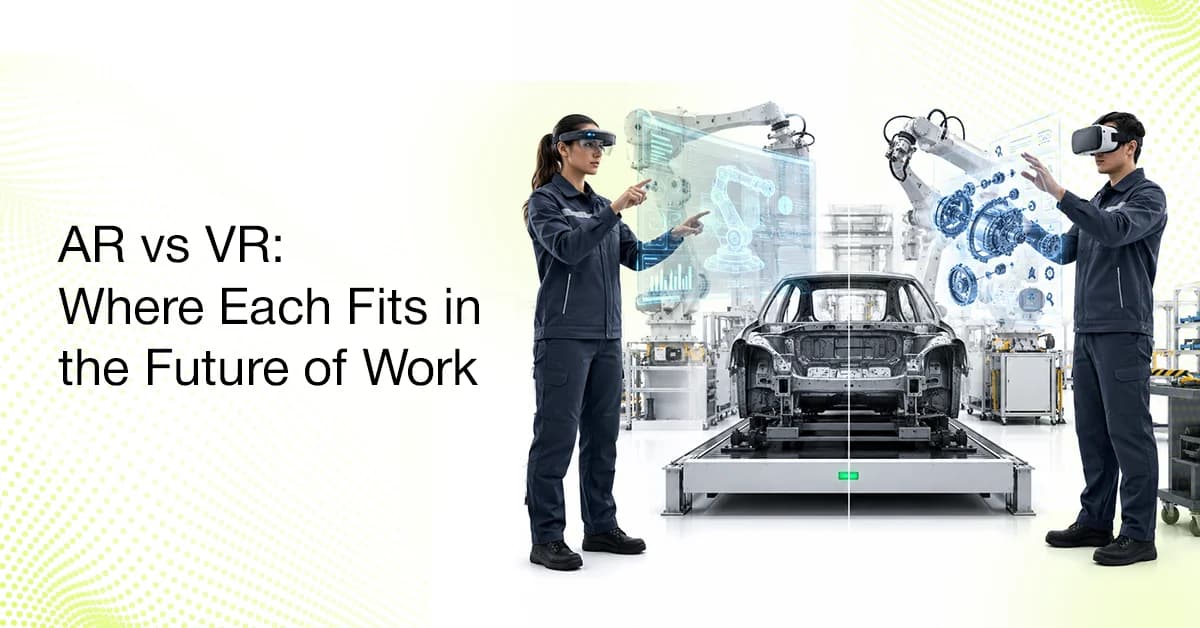
The simplest distinction between Augmented Reality and Virtual Reality lies in what the user sees.
In virtual reality, the environment the user sees is entirely computer-generated. For example, a heavy machinery worker enters a digital world where they are trained to use the heavy machinery in a simulated environment without even physically touching the machine.
In augmented reality, digital content is layered onto the real environment, allowing users to interact with both simultaneously. A maintenance technician wearing an AR device still sees the machine in front of them. Instructions, diagrams, asset information, or workflow guidance appear alongside the physical equipment.
This is also the difference that determines how the technologies can be best used in the workplace.
One of the strongest applications for virtual reality is Training. With the help of VR, workers can learn procedures, operate equipment, and experience high-risk situations which are simulated and thus, safe. They also do not need to spend time with actual equipments, saving training cost.
A few common use cases would be -
Safety drills
Emergency response simulations
Equipment familiarisation
Onboarding programmes
Technical skills training
As VR eliminates the operational risk in critical industries such as aviation, healthcare, defence, energy etc, mistakes during the training period become learning opportunities.
In the real world where actual work happens, the environment is unpredictable and continuously evolving. When machines have broken down, or equipments need inspection, problems need to be diagnosed - frontline workers need support in real time. This is where AR helps workers perform tasks with greater confidence and consistency, by adding contextual information to the physical environment.
Practical use cases for AR would be:
Maintenance and repair
Inspection and compliance
Troubleshooting
Remote expert assistance
Quality checks
Field service operations
Modern AR systems can not only provide digital assistance, but also recognise assets, retrieve documentation, display guided workflows, and connect workers to remote experts without interrupting work.
Recent advances in Agentic AI are making these experiences even more contextual. Information can be surfaced based on the asset being viewed, the task being performed, or the operational situation.
While many view AR and VR as competing technologies but actually, they solve different problems. VR helps workers learn with confidence and in a safe, simulated environment, and AR helps workers perform with confidence and efficiency supported by contextual guidance. Together, they create a stronger workforce development model.
With the hardware becoming more ergonomic and affordable, it is high time that organisations look at how they can accelerate adoption of these technologies and be prepared for the future of work.
At UnfoldXR, we are working at bridging the gap between the technology support that the frontline workers need and what is available. We are one single go-to platform that connects every aspect of a task from before it begins, to during execution and after it is completed providing real-time support to the worker on the field or the floor.
To know more about UnfoldXR SaaS platform and what we are offering write to us at info@unfoldxr.com.