
July 20, 2026 • 4 min reading
By UnfoldXR, Indrabati Sarkar / Lead - Brand Voice & Content (Consultant)
Marketshare wise and from popular conversations, it has been seen that most people think of ChatGPT when asked about AI. With generative AI becoming the public face of artificial intelligence and OpenAI being one of the earliest players in the market, this is more than expected.
Claude, Gemini, Grok and more are writing emails, creating presentations, answering questions, generating images, and even helping with coding. For most people, AI has become how they find and process information now.
But answering a generic query is not now AI for frontline work functions. The AI running inside a factory, a warehouse, or a power plant isn't there to write mail but to help people get work done. All this time the AI for the workplace focused on teams working behind a desk but finally, we are addressing the 80% of the workforce that works at the frontline.
Different types of work need different capabilities from Artificial Intelligence. Like Generative AI creates content, Predictive AI analyses historical data to forecast what might happen next, whether it's equipment failure or customer demand. But what is most relevant to frontline work is Agentic AI, which operates closer to execution. It understands tasks by accessing the right information, and then helps workers with relevant guidance to make decisions as work unfolds. While all these are AI but their distinct use cases matter.
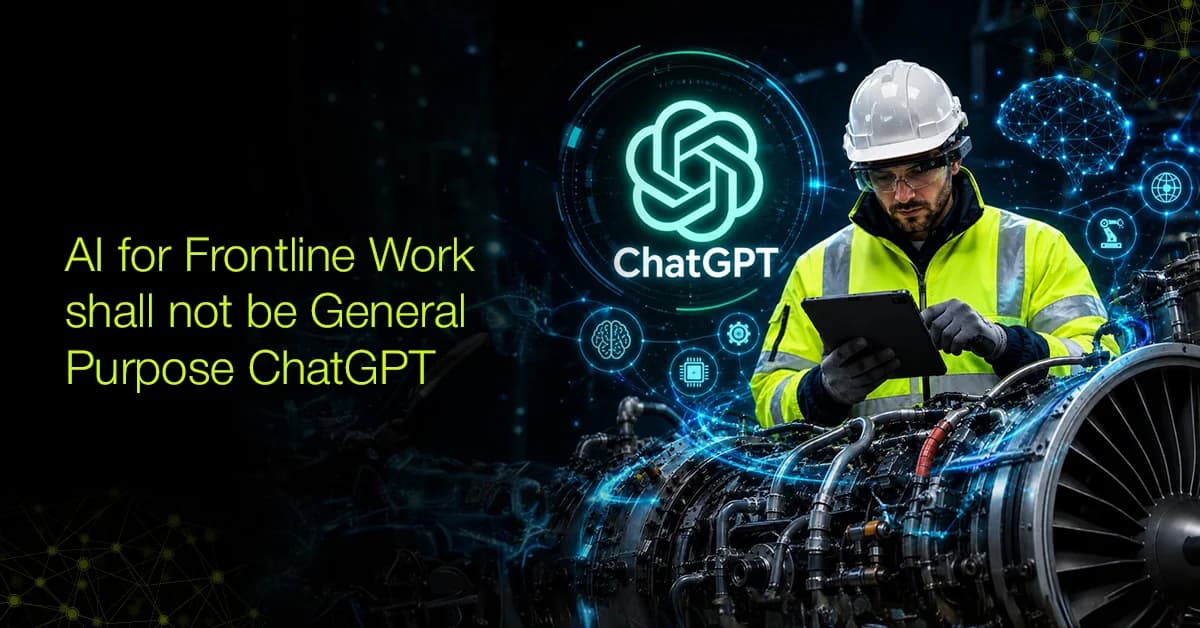
Frontline work is mission critical and therefore, leaves very little room for improvisation. A technician repairing industrial equipment cannot afford generic instructions which are not 100% fool-proof. If a healthcare worker receives AI recommendations which are strictly from an approved document it becomes risky. A field engineer working on critical infrastructure needs information that is relevant to the asset, the location, and the task at hand and not random information off the net. This is why Agentic AI in frontline operations cannot behave like a general-purpose chatbot.
At UnfoldXR, our agentic AI AVA was never designed to answer everything, only the things related to the work at hand.
It is trained to understand the operational environment of the worker. Working within the enterprise knowledge, approved workflows, asset information, operating procedures, and permissions defined by the organisation, AVA has been designed to be responsible. The limitation of functioning within a guardrail is very much intentional.
While the temptation with AI is to make it capable of doing more but in industrial environments, knowing what not to do is often just as important.
A worker asking for maintenance guidance should not receive information from an unrelated asset. A technician should not be able to access documentation they are not authorised to view. If AVA is uncertain, it should escalate the issue instead of attempting to generate an answer that may be incorrect and that is why it is trained with a layer of counsel which always flags any anomalies, lack of information and will not draw its own conclusions.
These are not technical constraints but operational guardrails. AVA functions only within work situations -
Assists workers before, during, and after execution
Retrieves documentation, guides inspections, supports troubleshooting, and captures operational knowledge
Not designed to answer personal questions or become another enterprise chatbot competing for attention.
The idea behind building AVA with such strict boundaries was to develop UnfoldXR’s Agentic AI with a clear focus on helping the workers without any further cognitive load and have a reliable system for organisations.
The success of AI deployment in Enterprise set ups depends heavily on how much the workers are trusting the system. But blind trust is also not expected in a highly dynamic environment like frontline but for the human workers to find genuine help from the AI system.
So when they receive a recommendation that matches the equipment in front of them or gets access to the documentation that is always the latest approved version, workers find these to be signs of a dependable system. Moreover, an AI system that admits uncertainty, is far more reliable for the organisation than one that invents false confidence in workers.
Enterprise AI is entering a stage where capability alone is no longer enough. Businesses have to evaluate AI systems by how responsibly they operate and how transparently they make decisions. For frontline industries these qualities are non-negotiable.
At UnfoldXR, our objective isn't to build an AI that can answer any question. We would rather build one that workers can trust when their decisions affect safety, productivity, or operational continuity. That is the standard we believe frontline AI should be held to and we shall live by it.
To know more about how our agentic AI, AVA, helps workers through every stage of work visit our website www.unfoldxr.com or write to us at info@unfoldxr.com.