
October 27, 2026 • 5 min reading
By UnfoldXR, By Indrabati Sarkar, Lead - Brand Voice & Content (Consultant)
AI, AR and Computer Vision: Turning Visual Intelligence into Frontline Productivity
Artificial intelligence (AI) and computer vision are becoming increasingly important to industrial operations, as computer vision enables machines to interpret images and identify objects, defects and changes in equipment, while AI helps analyse this information, recognise patterns and support decisions.Together, they are creating the opportunity for industrial technology to move from simply recognising objects to helping people make informed decisions around those objects.
Across manufacturing, automotive, energy and field service, businesses are exploring how AI-powered vision systems can improve inspection accuracy, reduce downtime and help workers resolve problems faster. 42% expected productivity increase from AI by 2030 (IBM Institute of Business Value)
As it remains, identifying a defect or recognising a component is only part of the challenge for the frontline teams, as they also need access to the right technical information and guidance to determine what action to take.
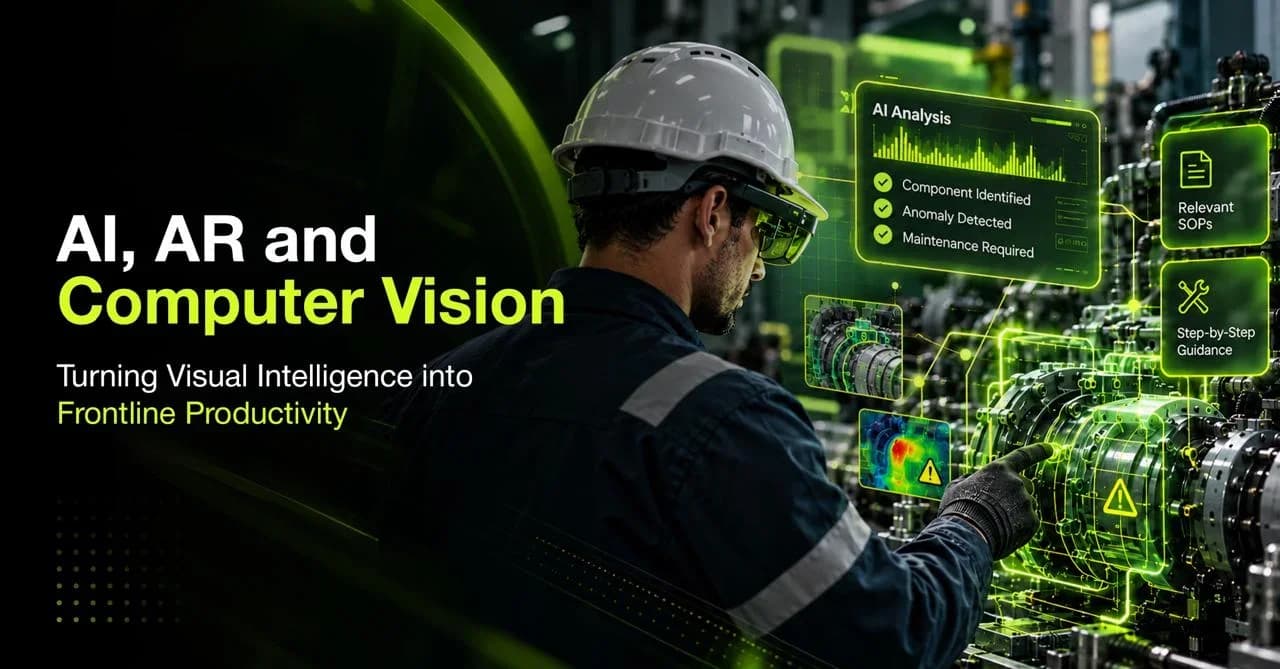
The value of combining AI and computer vision lies in connecting visual intelligence with practical action. Consider a technician inspecting a machine on a factory floor. Computer vision can identify the equipment and detect a visible anomaly. AI can connect that observation to maintenance records, technical documentation and troubleshooting procedures. With augmented reality (AR), the technician can access relevant instructions while inspecting the machine.
Each technology has a distinct role here. Computer vision interprets visual information, AI helps make sense of it, and AR brings relevant information into the worker’s environment. When these capabilities work alongside enterprise knowledge and digital workflows they can help frontline workers make better-informed decisions and complete tasks more efficiently.
Manufacturing, automotive, energy and field service operations generate large volumes of technical information. Yet frontline workers often have to navigate manuals, equipment records, standard operating procedures (SOPs) and disconnected software while performing physical tasks and lose up to 30% of their productive time in searching for information (McKinsey).
According to Deloitte, industrial downtime costs up to US$50 billion annually. Some of the challenges that create unwanted delays and efficiency issues leading to business loss are -
● Information spread across manual documents or disconnected systems.
● Expertise is concentrated in experienced workers which is lost when the employee leaves.
● Workers facing repetitive tasks and tight production schedules may miss defects during manual inspections.
● Highly sophisticated technology and complex machinery may cause delays in identifying faults and finding the correct repair procedure can extend downtimes.
● Recording observations, capturing evidence and completing checklists add to the workload and misses lead to complications
AI and computer vision can help address these problems when connected to reliable enterprise information and designed around the realities of frontline work. IBM Institute of Business Value reports, organisations deploying AI operationally outperformed peers by 44% on critical metrics, including measures related to retention and revenue.
1. Faster Troubleshooting and Problem Resolution: When equipment fails, technicians often lose valuable time identifying the problem, locating maintenance records and finding the right repair procedure. Computer vision can identify equipment and visible anomalies, while AI retrieves relevant technical documentation and troubleshooting guidance, helping workers move from diagnosis to resolution faster.
2. More Accurate and Consistent Quality Inspections: Manual inspections can miss defects, and variations in inspection practices can affect product quality. Computer vision can detect visible defects and deviations against defined quality criteria, while AI helps classify findings and identify recurring patterns, enabling more consistent inspections and better-informed quality decisions.
3. Proactive Equipment Maintenance: Equipment problems can go unnoticed until they cause a breakdown, disrupting production and increasing repair costs. Computer vision can identify visible signs of wear or deterioration, while AI can analyse these observations alongside maintenance records and other available data to flag potential issues for investigation before they lead to greater disruption.
4. Faster Training and On-the-Job Learning: New or less experienced workers may struggle with unfamiliar equipment, complex procedures and knowledge that experienced technicians have accumulated over years. AI-assisted guidance and AR workflows can provide contextual instructions, demonstrate task sequences and make technical knowledge accessible while workers perform the job, reducing dependence on constant supervision. 100% of respondents of the 2024 Field Service AI Report reported that AI was already improving workforce development or knowledge sharing to some extent.
5. Automated Documentation and Better Traceability: Recording inspection results, capturing evidence and completing checklists can add to the workload and leave gaps in maintenance or quality records. AI-enabled digital workflows can help capture photographs, observations, checklist responses and task completion records as work progresses, making documentation more consistent and easier to retrieve for audits, troubleshooting and future maintenance.
According to reports by Boston Consulting Group, 39% use time saved through AI for higher-value or strategic work.
UnfoldXR connects AI, computer vision, enterprise knowledge and AR-guided workflows to support frontline work. Its capabilities include intelligent asset scanning, access to relevant SOPs and technical documentation, contextual Agentic AI assistance, guided workflows, remote expert collaboration and digital evidence capture. Workers can access support through mobile devices, tablets and compatible smart glasses.
The objective is to connect what a worker sees with the information needed to understand the situation and carry out the next step. Rather than treating visual recognition, knowledge retrieval and task execution as separate activities, UnfoldXR brings them into a connected workflow.
AI and computer vision deliver practical value when their outputs help people solve real operational problems. For frontline teams, that means finding information faster, making inspections more consistent and completing work with better guidance and documentation.
Explore how UnfoldXR can help your organisation connect AI, computer vision and frontline workflows. Get in touch with our team to discuss your use case. Write to us at info@unfoldxr.com.