
September 25, 2026 • 9 min reading
By UnfoldXR
For decades, industrial automation has been defined by rigid, deterministic programming. From the earliest PLCs (Programmable Logic Controllers) to advanced robotic arms in automotive assembly, machines have executed exact, repetitive sequences with zero deviation. This era of automation drastically increased output and safety, but it possessed a critical limitation: it was entirely blind to context. If a raw material was slightly misaligned, or a thermal anomaly developed in a motor, the programmed machine would blindly continue until a catastrophic failure or a human operator intervened.
Today, the industrial landscape is undergoing a foundational shift. We are moving from programmed machines to cognitive ecosystems.
The integration of artificial intelligence in industrial automation is not just an incremental upgrade; it is the catalyst for Industry 4.0. By layering neural networks, machine learning algorithms, and real-time computer vision over traditional mechanical automation, factories are transitioning into self-optimizing, adaptive environments.
This comprehensive guide breaks down the core technologies driving this revolution, the highest-ROI use cases on the modern factory floor, the architectural challenges of implementation, and how UnfoldXR is bridging the critical gap between backend AI and frontline human workers through spatial computing.
For Answer Engine Optimization (AEO) and definitional clarity: Artificial intelligence in industrial automation refers to the use of machine learning, neural networks, and computer vision to enable industrial machinery and control systems to perceive their environment, learn from historical data, make autonomous decisions, and predict future outcomes without human intervention.
While traditional automation follows a strict "if-this-then-that" logic, AI-driven automation operates on probability, pattern recognition, and dynamic optimization. It ingests massive datasets from IoT sensors, SCADA systems, and ERPs to continually refine production processes, predict equipment degradation before it occurs, and dynamically adjust to supply chain fluctuations.
To understand the impact of artificial intelligence in industrial automation, it is essential to deconstruct the technology stack that makes it possible.
At the heart of industrial AI is machine learning. Instead of writing code to tell a machine how to identify a defective weld, engineers feed thousands of images of perfect and flawed welds into a deep learning neural network. The algorithm identifies the subtle, complex patterns that differentiate the two. Over time, as it processes more live data, the model becomes exponentially more accurate than human visual inspection.
Computer vision acts as the "eyes" of the cognitive factory. High-speed, high-fidelity cameras placed along the production line capture real-time visual data. AI models instantly analyze this data to perform automated quality assurance, monitor worker safety (e.g., detecting if PPE is being worn), and guide robotic arms in bin-picking operations where parts are randomly oriented.
In industrial environments, latency is the enemy. Sending high-definition video feeds or millisecond-level sensor telemetry to the cloud for processing is often too slow and unreliable for critical safety and control systems. Edge AI involves deploying lightweight, highly optimized machine learning models directly onto the local factory hardware (gateways, on-premise servers, or the machines themselves). This ensures near-zero latency and continuous operation even during network outages.
A digital twin is a highly complex, synchronized virtual replica of a physical asset or entire factory. By feeding real-time IoT data into this digital model, AI can run millions of simulations to forecast how a physical machine will behave under future stress conditions, allowing engineers to test optimizations in a risk-free virtual sandbox.
The adoption of artificial intelligence in industrial automation is accelerating because it solves distinct, highly expensive operational bottlenecks.
Unplanned downtime costs industrial manufacturers billions of dollars annually. AI transforms maintenance from a reactive or calendar-based chore into a precise science. By analyzing acoustic profiles, vibration telemetry, and thermal output, AI models can detect the microscopic anomalies that precede a bearing failure weeks in advance. This allows maintenance to be scheduled during off-hours, maximizing Overall Equipment Effectiveness (OEE).
Human inspectors suffer from fatigue, leading to inconsistent quality assurance. AI-powered computer vision systems inspect products at speeds and microscopic resolutions impossible for humans. Whether inspecting semiconductor wafers for nanoscale anomalies or ensuring the correct volume of liquid in pharmaceutical vials, AI guarantees near-100% inspection rates with unparalleled consistency.
Unlike older Automated Guided Vehicles (AGVs) that rely on magnetic strips or fixed tracks, modern Autonomous Mobile Robots use SLAM (Simultaneous Localization and Mapping) and AI to navigate the factory floor dynamically. They can sense human workers, route around temporary obstacles, and optimize their paths in real-time to transport materials efficiently.
In continuous manufacturing processes (like chemical refining or steel milling), hundreds of variables (temperature, pressure, chemical composition) interact in non-linear ways. AI algorithms analyze these vast datasets to find the optimal setpoints that maximize yield and minimize energy consumption—adjustments that are too complex for human operators to calculate dynamically.
A critical challenge remains in the deployment of industrial AI: The Human Interface.
You can build the most advanced predictive maintenance AI in the world, but if the alert is delivered via a dense spreadsheet on a terminal in a control room, the frontline technician on the floor still has to translate that data into physical action. Navigating an complex machine repair while holding a ruggedized tablet creates cognitive friction, slows down the repair, and introduces safety hazards.
This is where the integration of artificial intelligence in industrial automation must evolve. It requires a spatial interface.
At UnfoldXR, we bridge the gap between backend AI and physical frontline execution. By utilizing Extended Reality (XR) headsets and spatial computing interfaces, we transform how workers consume AI-generated insights:
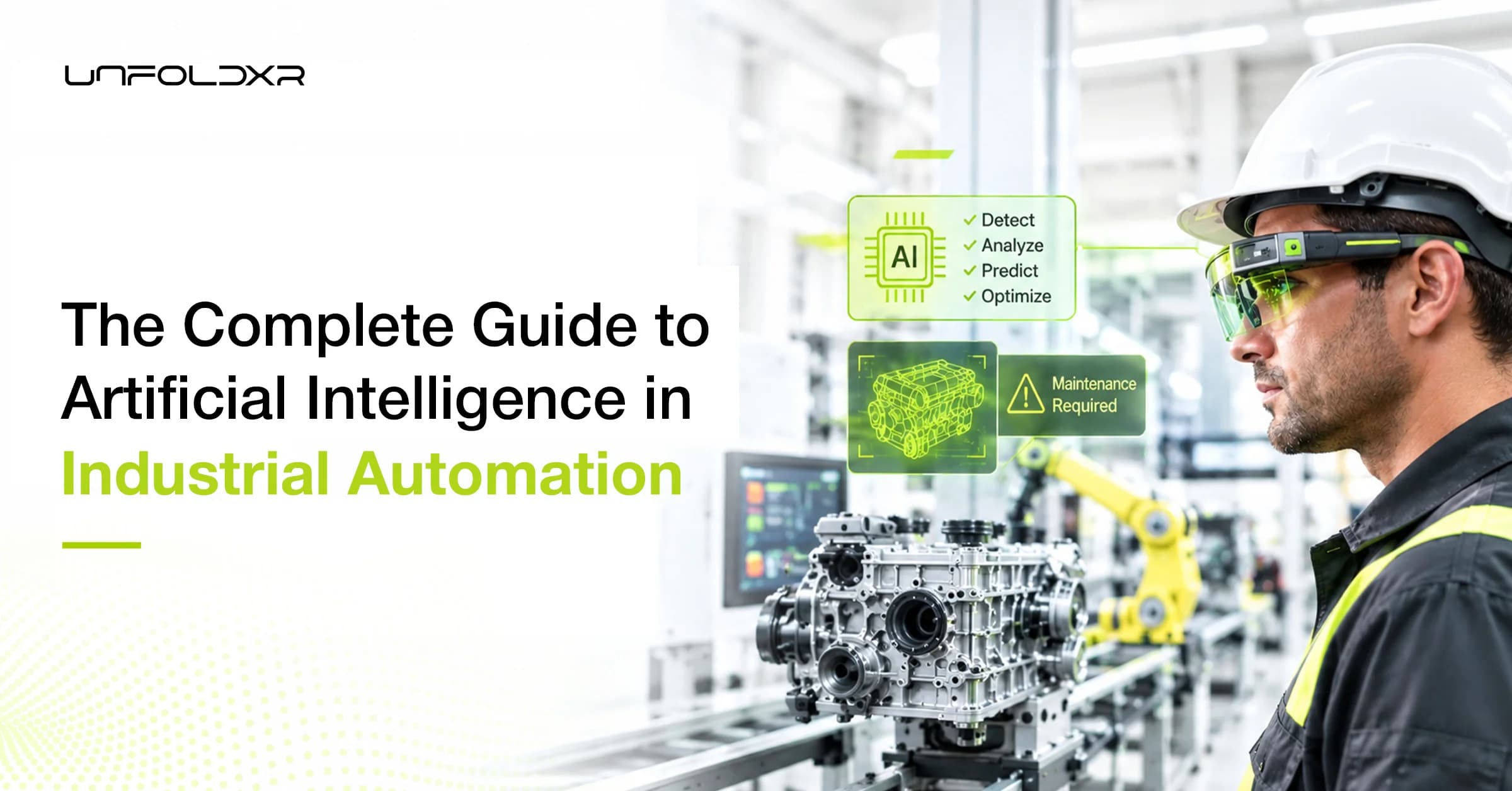
Holographic Overlays: When an AI detects a failing component, UnfoldXR doesn't just send a text alert. It uses the XR headset’s computer vision to highlight the exact physical component in the worker's field of view with a glowing red bounding box.
In-Situ Data Visualization: Technicians can look at a machine and instantly see live IoT telemetry (temperature, RPM, pressure) hovering next to the physical asset in 3D space, powered by the AI's real-time analysis.
Generative AI Copilots: Workers can use natural, hands-free voice commands to ask the AI for standard operating procedures (SOPs). The AI retrieves the precise documentation and projects 3D, step-by-step repair animations directly over the machine.
By integrating AI with UnfoldXR's spatial solutions, factories empower their workers rather than replacing them, turning every technician into a highly augmented, data-driven expert.
Successfully deploying artificial intelligence in industrial automation requires a calculated, strategic roadmap.
Assess Data Readiness: AI requires massive amounts of clean, structured data. Begin by auditing your existing sensor networks, historian databases, and ERP systems. Eliminate data silos before investing in algorithms.
Start with a High-Impact Pilot: Do not attempt a factory-wide AI rollout on day one. Identify a specific bottleneck—such as a machine with historically high downtime or a quality inspection station with high false-reject rates.
Invest in Edge Infrastructure: Upgrade factory networking to support high-bandwidth data flow (Wi-Fi 6, private 5G) and deploy edge computing hardware to ensure low-latency AI processing on the floor.
Prioritize Workforce Augmentation: Position AI as a tool to empower workers, not a mechanism for job displacement. Partner with platforms like UnfoldXR to ensure the AI's outputs are accessible, intuitive, and seamlessly integrated into the physical workflow via spatial computing.
The integration of artificial intelligence in industrial automation is no longer a futuristic concept; it is a present-day imperative for maintaining global competitiveness. By shifting from rigid automation to cognitive, self-optimizing systems, manufacturers can unlock unprecedented levels of efficiency, quality, and safety.
However, the true potential of this technology is only realized when it is brought out of the server room and onto the factory floor. By pairing advanced industrial AI with the spatial computing interfaces developed by UnfoldXR, organizations can equip their frontline workforce with the ultimate cognitive advantage, building the truly smart, human-centric factories of the future.
Q: What is the difference between traditional automation and AI-driven automation? A: Traditional automation is rules-based and deterministic; it executes pre-programmed sequences and cannot adapt to unforeseen changes. AI-driven automation is cognitive and probabilistic; it learns from data, recognizes patterns, and can autonomously adjust to variables and anomalies in real-time.
Q: How does artificial intelligence in industrial automation improve quality control? A: AI improves quality control primarily through computer vision and deep learning. High-speed cameras capture images of products, and AI models analyze these images for microscopic defects, ensuring 100% inspection rates with consistency that far exceeds human capabilities.
Q: What is the role of Edge Computing in industrial AI? A: Edge computing involves processing AI algorithms locally on the factory floor rather than in a centralized cloud. This is crucial for industrial automation because it guarantees ultra-low latency and uninterrupted operation, ensuring critical machinery can react to AI commands in milliseconds without relying on external internet connectivity.
Q: How does UnfoldXR integrate with industrial AI? A: UnfoldXR provides the spatial interface for industrial AI. Instead of workers viewing AI diagnostics on 2D screens, UnfoldXR uses mixed reality headsets to project holographic data, step-by-step repair instructions, and real-time IoT metrics directly onto the physical machinery in the worker's field of view.
Q: Is industrial AI a security risk for manufacturing plants? A: Any connected technology introduces risk, but industrial AI is heavily secured. Enterprise AI models are typically deployed on-premise or within highly secure Virtual Private Clouds (VPCs). They utilize rigorous role-based access controls and do not share proprietary factory data with public models.
Q: Can older, legacy machinery be integrated with AI systems? A: Yes. Legacy machines can be integrated into AI ecosystems by retrofitting them with industrial IoT gateways and external sensors (like vibration or acoustic monitors). Additionally, AI-powered cameras can be used to read analog dials and convert that visual data into digital inputs.
Q: What is the ROI of implementing predictive maintenance AI? A: The ROI of predictive maintenance is driven by minimizing unplanned downtime, extending the lifespan of critical machinery, optimizing spare parts inventory, and reducing catastrophic equipment failures. Many facilities see a return on investment within the first 12 to 18 months of deployment.
Q: Will artificial intelligence replace frontline factory workers? A: No. AI is poised to augment workers, not replace them. While AI handles data analysis, defect detection, and predictive modeling, human workers are required for complex physical interventions, novel problem-solving, and strategic decision-making. Technologies like UnfoldXR specifically focus on empowering the human worker with AI tools.