
September 25, 2026 • 12 min reading
By UnfoldXR
For most knowledge workers, getting help is easy.
Open Teams. Search a knowledge base. Message an expert. Join a video call. Pull up a document.
For the deskless workforce, the same problem looks very different.
A technician standing beside a machine cannot simply walk back to a laptop every time something unexpected happens. A field engineer cannot wait for a subject-matter expert to travel to the site. A maintenance worker may have the right SOP but still need help interpreting what they are seeing in front of them.
This creates a productivity gap that is rarely caused by a lack of employee capability.
It is caused by distance from expertise.
And as organizations operate increasingly distributed workforces while dealing with skills shortages, complex equipment, tighter service-level agreements, and pressure to do more with fewer people, that gap becomes expensive.
This is where AR remote assistance for the deskless workforce moves from an interesting technology concept to a practical operational capability.
Consider a field technician troubleshooting a piece of industrial equipment.
The technician encounters an unfamiliar fault. They call a senior engineer. The engineer asks for photographs or a video. The technician tries to explain what they are seeing. The expert asks them to inspect another component. The technician moves the camera. There is more back-and-forth.
Eventually, the expert understands the problem.
The actual repair may take 15 minutes.
But the organization has already lost considerably more time to finding, communicating, interpreting, and transferring knowledge.
This is one of the less visible productivity costs in deskless operations.
The worker isn't necessarily doing the task slowly. The workflow around the task is slow.
Research from Deloitte highlights a similar technology gap: 82% of surveyed frontline workers said better technology and controls could improve their productivity by improving safety and communication.
That matters because frontline workers represent the overwhelming majority of the global workforce. Microsoft estimates that frontline workers account for more than 80% of the global workforce, yet these workers have historically been underserved by workplace technology.
The productivity opportunity, therefore, isn't limited to automating a task.
It is about removing the friction between a worker and the expertise required to complete that task.
Remote support is not new.
Workers have been calling experts, sending photos, sharing videos, and joining video calls for years.
The problem is that conventional remote support was designed around communication, not necessarily execution.
A video call can tell an expert what is happening. But it does not automatically place the expert's knowledge into the worker's physical environment.
That distinction matters.
Imagine an expert saying:
“Look behind the panel, find the second connector from the left, and check whether it is seated properly.”
The worker still has to translate verbal instructions into physical action.
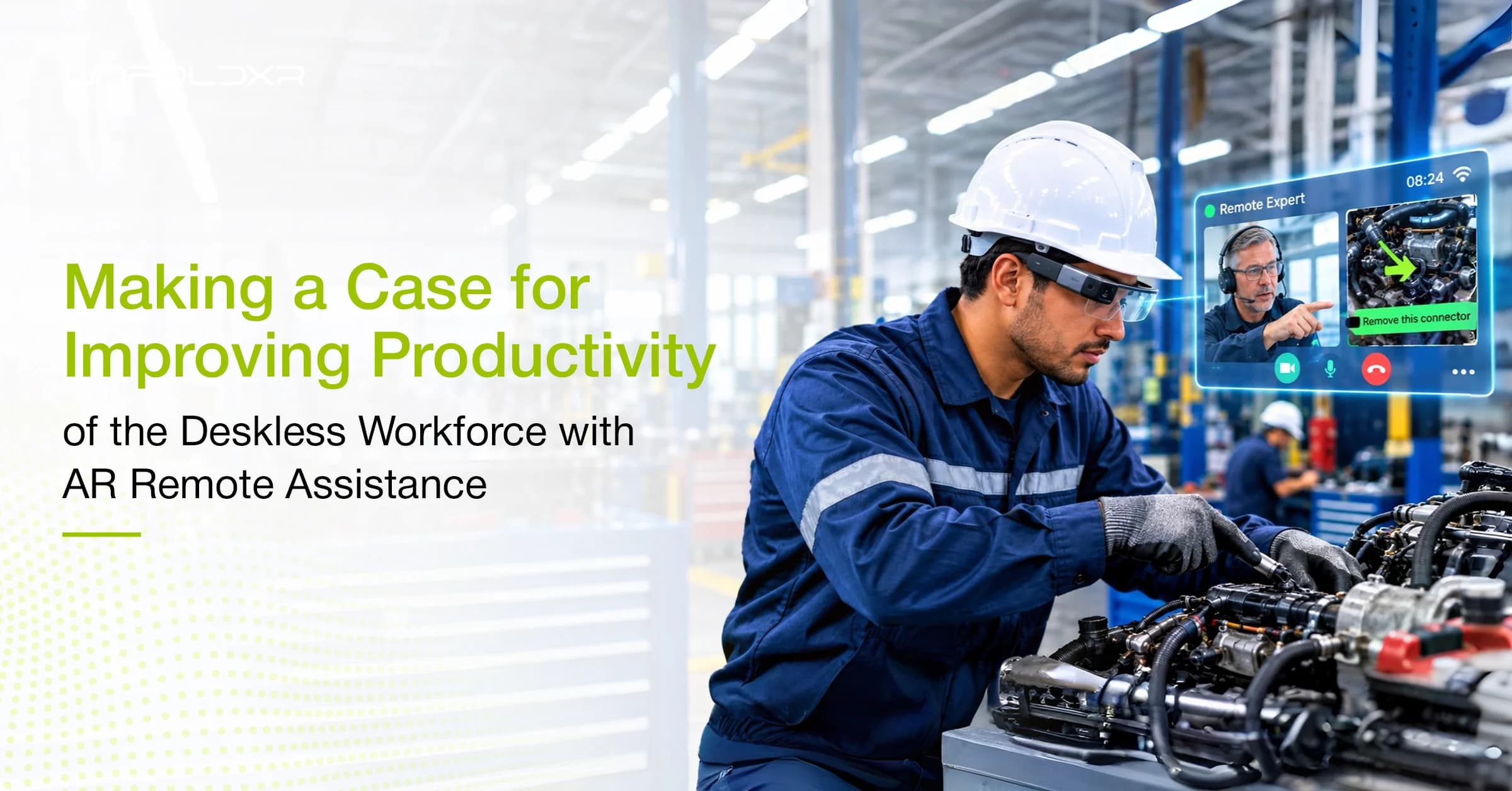
Now imagine the expert being able to see exactly what the worker sees and place a visual marker directly over the relevant component.
The interaction changes from:
to:
That is the fundamental proposition behind AR remote assistance.
Augmented reality can create a shared visual layer between the person performing the work and the person providing expertise.
The frontline worker can use a smartphone, tablet, wearable, or smart glasses to stream their environment. A remote expert can then provide contextual guidance through visual annotations, markers, instructions, or other forms of assistance.
Instead of separating the worker from the work environment to access information, AR brings assistance into the environment where the work is happening.
Research into industrial AR applications has specifically explored this model for maintenance, where remote experts can access the context of an on-site task and guide technicians remotely.
That creates several potential productivity advantages.
One of the biggest costs in distributed operations is moving people.
When a problem requires specialist knowledge, organizations often have three choices:
send an expert to the site
send the asset to a specialist
attempt to resolve the issue remotely
AR remote assistance strengthens the third option.
The expert does not necessarily need to be physically present to contribute their knowledge.
This can reduce unnecessary travel, accelerate troubleshooting, and make scarce expertise available across multiple locations.
The value becomes particularly significant when an organization has a small number of highly experienced specialists supporting a large distributed workforce.
The expert becomes a force multiplier rather than a resource tied to a particular location.
A major limitation of conventional remote support is that language is an imperfect interface for physical work.
Workers see objects.
Experts often communicate through words.
AR introduces a shared visual reference.
A remote expert can point to a component, highlight an area, indicate a sequence, or visually direct attention to the part of the environment that matters.
This reduces ambiguity.
For complex maintenance and field-service environments, that can mean fewer clarification cycles and faster movement from diagnosis to action.
This is where AR remote assistance becomes particularly interesting from a productivity perspective.
The goal isn't simply to enable better conversations.
The goal is to help the worker complete the task.
Deloitte has noted that AR/VR guidance and collaboration applications are being used in industries including aerospace, manufacturing, and oil and gas to improve worker productivity and accuracy by reducing time spent accessing information and consulting colleagues. Its research also cites examples such as Boeing reducing wiring production time after replacing assembly manuals with smart-glasses displays.
The underlying principle is simple:
Every minute spent searching, waiting, interpreting, or escalating is a minute that is not being spent executing.
There is, however, an important distinction between remote assistance and frontline intelligence.
Remote assistance is reactive.
A worker encounters a problem → the worker calls an expert → the expert provides assistance.
That model is valuable, but it still depends on an expert being available.
The next evolution is to reduce the number of situations that require escalation in the first place.
This is where AR becomes more powerful when combined with AI.
Instead of simply connecting workers to remote experts, an intelligent frontline platform can understand the context of the task, surface relevant information, guide the worker through a workflow, and escalate to a human expert when human judgment is genuinely required.
The workflow becomes:
rather than:
That is a fundamentally different productivity model.
Traditional frontline enablement has largely been built around documents.
SOPs.
PDF manuals.
Training modules.
Checklists.
Knowledge bases.
These resources are useful — but usefulness depends on the worker finding the right information and interpreting it correctly at the right moment.
That creates what could be called a knowledge-to-action gap.
The information exists.
The worker needs it.
But the two are not always connected efficiently.
AR can narrow this gap by placing instructions in the worker's visual and physical context.
AI can take the model further by helping determine which information matters right now.
For example, instead of asking a technician to search through a 40-page maintenance manual, an intelligent system could identify the relevant procedure based on the asset, task, environment, or workflow and surface the appropriate guidance.
This is where the combination of AR + AI + workflow intelligence becomes more strategically important than AR alone.
There is another reason organizations should be careful about defining frontline productivity purely as “doing things faster.”
Speed without accuracy can increase rework.
Speed without safety can increase risk.
Speed without knowledge transfer can create dependency on a small number of experts.
The real productivity equation is broader:
AR remote assistance can contribute across several of these dimensions.
A worker who receives precise visual guidance may spend less time interpreting instructions.
A technician who gets immediate access to an expert may avoid a repeat visit.
A new employee who receives contextual assistance may perform a task without requiring continuous supervision.
An experienced worker who captures a workflow can help convert individual expertise into reusable organizational knowledge.
The technology therefore becomes valuable not because it adds an AR layer, but because it can remove friction from the entire execution cycle.
For organizations evaluating AR remote assistance, the business case should not start with the question:
It should start with:
“Where is our organization losing productivity because expertise cannot reach the worker quickly enough?”
That question leads to measurable operational metrics.
How long does it take to resolve an issue from the moment it is reported?
How often is the problem resolved without a second visit or escalation?
How frequently do specialists travel because their expertise cannot be delivered remotely?
How much operational time is lost while workers wait for assistance?
How many issues require intervention from senior technicians or subject-matter experts?
How quickly can a less-experienced worker perform complex tasks independently?
How much critical operational knowledge exists only in the heads of a small number of experienced employees?
These metrics turn AR from an innovation project into an operational productivity initiative.
The strongest use cases tend to share one characteristic: the worker is physically present, but the expertise they need may not be.
Technicians can receive visual assistance during machine maintenance, troubleshooting, inspection, and assembly.
Engineers can connect with remote specialists without waiting for an expert to reach the customer site.
Complex inspection, maintenance, and assembly workflows can benefit from hands-free access to instructions and specialist guidance.
Workers can receive contextual instructions while navigating physical environments and handling operational tasks.
Specialists can provide remote support while frontline staff remain focused on the patient or equipment.
Distributed teams can access specialist knowledge while working on geographically dispersed assets.
The common denominator isn't the industry.
It is the distance between the worker and the knowledge required to execute the job.
This is where the conversation around deskless productivity needs to evolve.
AR remote assistance solves one important problem:
But intelligent frontline platforms are beginning to address a larger question:
That shift matters.
A worker should not always have to know whom to call.
They should not always have to know which manual contains the answer.
They should not have to stop working to search for information.
And organizations should not have to repeatedly deploy their most experienced people to solve problems that can eventually be captured, structured, and reused.
This is the direction in which platforms such as UnfoldXR are designed to take frontline productivity.
UnfoldXR combines AI-powered workflows, contextual guidance, and AR-enabled experiences across devices including smart glasses, smartphones, and tablets. Its AVA agentic AI layer is designed to support frontline workers across the execution journey — from accessing relevant information and receiving guidance to creating and following workflows.
That makes AR one part of a broader architecture.
The objective isn't to put more technology in front of the worker.
It is to put less friction between the worker and the work.
AR can create an impressive demonstration.
A technician sees digital instructions overlaid on a machine.
An expert draws a marker in the worker's field of view.
A smart-glass interface displays information hands-free.
But enterprise value doesn't come from the demonstration.
It comes from what happens repeatedly after implementation.
If a technician resolves an issue without waiting for an expert, that is value.
If a field engineer avoids a second site visit, that is value.
If a new worker can execute a complex workflow with less supervision, that is value.
If an organization's best experts can support ten teams instead of physically travelling to ten sites, that is value.
If critical knowledge stops disappearing when experienced employees leave, that is value.
The strongest AR deployments therefore shouldn't be measured by the number of devices deployed or AR experiences created.
They should be measured by how much operational friction they remove.
The deskless workforce does not need another digital destination.
It needs technology that fits the reality of physical work.
That means systems that understand that the worker may have both hands occupied. That the relevant information may depend on the machine in front of them. That a problem may require human judgment. That expertise may sit hundreds of miles away. And that the difference between a five-minute resolution and a two-hour escalation can have a direct operational impact.
AR remote assistance is an important step toward solving that problem.
But the larger opportunity is bigger than remote collaboration.
It is about creating a connected worker — one who can access human expertise, digital knowledge, AI-driven guidance, and intelligent workflows at the moment of execution.
That is where the productivity equation changes.
Not by asking frontline workers to work harder.
Not by replacing human expertise.
But by making the expertise around them more accessible, contextual, and actionable.
And when intelligence can move as easily as the worker does, the distance between knowing what to do and being able to do it begins to disappear.