
September 25, 2026 • 12 min reading
By UnfoldXR
Field Service Management has spent the last decade getting better at answering one fundamental question:
Scheduling became smarter. Dispatch became automated. Mobile work orders replaced paper. Asset histories became digital. GPS improved routing. Cloud platforms connected field operations with enterprise systems.
Yet one part of the equation remains surprisingly fragmented:
A technician can arrive at the right location, with the right work order and the right parts, and still lose valuable time figuring out what to do next.
They may need to search several systems for an equipment manual. Call a senior technician for guidance. Compare the current problem with previous service records. Interpret an unfamiliar fault. Document the resolution manually.
The field service system has successfully managed the job.
It has not necessarily helped the worker perform the job.
That distinction is becoming increasingly important as organizations deal with aging workforces, skills shortages, increasingly complex assets and growing expectations around service speed.
AI is creating an opportunity to close this gap.
The next generation of Field Service Management will not simply coordinate field work. It will increasingly understand the context of the work, support decisions and guide execution at the point of work.
And that could fundamentally change what it means to empower the deskless workforce.
Field service leaders have historically focused on measurable operational variables:
utilization
travel time
response time
schedule adherence
technician capacity
first-time fix rate
cost per visit
These metrics remain important.
But there is another layer of productivity hidden inside every field service operation:
Consider a technician who encounters an unfamiliar equipment fault.
The physical repair might take 20 minutes.
But before that happens, the technician may spend:
10 minutes searching for the right documentation
15 minutes calling an expert
10 minutes explaining the problem
another 10 minutes waiting for clarification
additional time documenting what happened
The repair itself isn't necessarily inefficient.
Salesforce's 2026 State of Field Service research found that technicians estimate spending more than seven hours a week on inefficient or low-value administrative work. The same research found that 96% of field service teams plan to use AI for knowledge retrieval, while 45% are already using AI for visual diagnosis or AR-guided repairs.
This points toward an important shift in how field-service productivity should be considered.
The question is no longer only:
How efficiently can we schedule our workforce?
It is increasingly:
How efficiently can our workforce access, interpret and act on intelligence while performing the job?
Traditional FSM platforms were built primarily around coordination.
A typical workflow looks something like this:
AI introduces another dimension:
For example:
A work order tells a technician that a machine is experiencing a pressure issue.
AI can potentially combine the work order with:
asset history
previous service records
equipment specifications
sensor data
known failure patterns
technician knowledge
relevant SOPs
previous resolutions
The result isn't simply more information.
It is context.
And context is what turns information into something operationally useful.
IBM describes AI in field service as enabling capabilities such as intelligent scheduling, predictive maintenance, knowledge retrieval and data-driven decision-making by connecting information across assets, technicians and service operations.
But there is a critical distinction.
Much of this intelligence traditionally remains at the management layer.
The bigger opportunity is to push that intelligence down to the person actually interacting with the asset.
Enterprise organizations have spent years connecting systems.
CRM connects sales activity.
ERP connects financial and operational processes.
FSM connects field operations.
Knowledge management connects information.
IoT connects assets.
AI is now creating another layer that can connect these sources of intelligence.
But there is a risk.
Organizations can build an incredibly intelligent technology stack and still leave the frontline worker navigating five different interfaces.
For a deskless worker, the interface problem is particularly important.
A technician may not be sitting at a desk.
They may be:
standing beside heavy machinery
working outdoors
wearing protective equipment
operating with both hands
working in a noisy environment
moving between physical assets
dealing with an urgent customer issue
The technology therefore has to adapt to the worker.
Not the other way around.
This is why AI field service management should not be viewed simply as AI added to an FSM platform.
The more interesting development is the emergence of an intelligence layer that travels with the worker.
For years, enterprise knowledge management has operated on a relatively simple assumption:
That assumption becomes weaker in complex field environments.
Finding a 70-page equipment manual is not the same as knowing which three pages matter.
Searching for “pump failure” may produce dozens of possible procedures.
The technician still has to interpret them.
AI changes the economics of this interaction.
Instead of asking the worker to find the answer, AI can potentially help determine:
That moves field service technology from:
toward:
The distinction may appear subtle, but operationally it is significant.
The first model makes the technician responsible for navigating enterprise knowledge.
The second makes technology responsible for bringing relevant knowledge into the workflow.
This is one of the most important principles for designing AI for the deskless workforce.
The objective shouldn't be to give frontline workers access to every piece of enterprise information.
That can actually increase cognitive load.
The objective is to provide the right information at the right moment, in the right format, with enough context to act on it.
Consider a field engineer inspecting a piece of equipment.
A conventional system might provide:
Asset ID: 18492
Service history: 26 records
Documentation: 14 files
Open tickets: 3
Maintenance SOP: available
An intelligent system could potentially provide something much more operational:
Pressure anomaly detected. Similar issue recorded twice in the past six months. Inspect valve assembly B first. Follow Procedure 4.2 if pressure remains above threshold.
The second experience doesn't necessarily contain more information.
It contains more intelligence.
That distinction will increasingly define the value of AI in field operations.
Field service organizations often have an uneven distribution of expertise.
A relatively small group of highly experienced technicians may hold a disproportionate amount of operational knowledge.
They know:
which failure patterns matter
which symptoms are misleading
which components usually fail together
which workaround is safe
which situations require escalation
The problem is that expertise doesn't scale particularly well when it exists only inside people's heads.
One senior engineer can only be in one place at a time.
A phone call extends their reach.
Remote assistance extends it further.
AI creates the possibility of extending it again by capturing, structuring and reusing parts of that expertise.
This is one of the most consequential applications of AI in frontline operations.
The objective isn't to replace the expert.
It is to make the expert's knowledge available to more workers.
That creates a multiplier effect.
The organization becomes less dependent on physical proximity to its most experienced people.
AI alone doesn't solve the interface problem.
A technician can receive an excellent answer and still need to figure out how that answer applies to the physical environment.
This is where augmented reality becomes strategically relevant.
AR connects digital information with the physical object being worked on.
Instead of:
“Check the second connector from the left.”
the worker can potentially see the relevant connector identified within their environment.
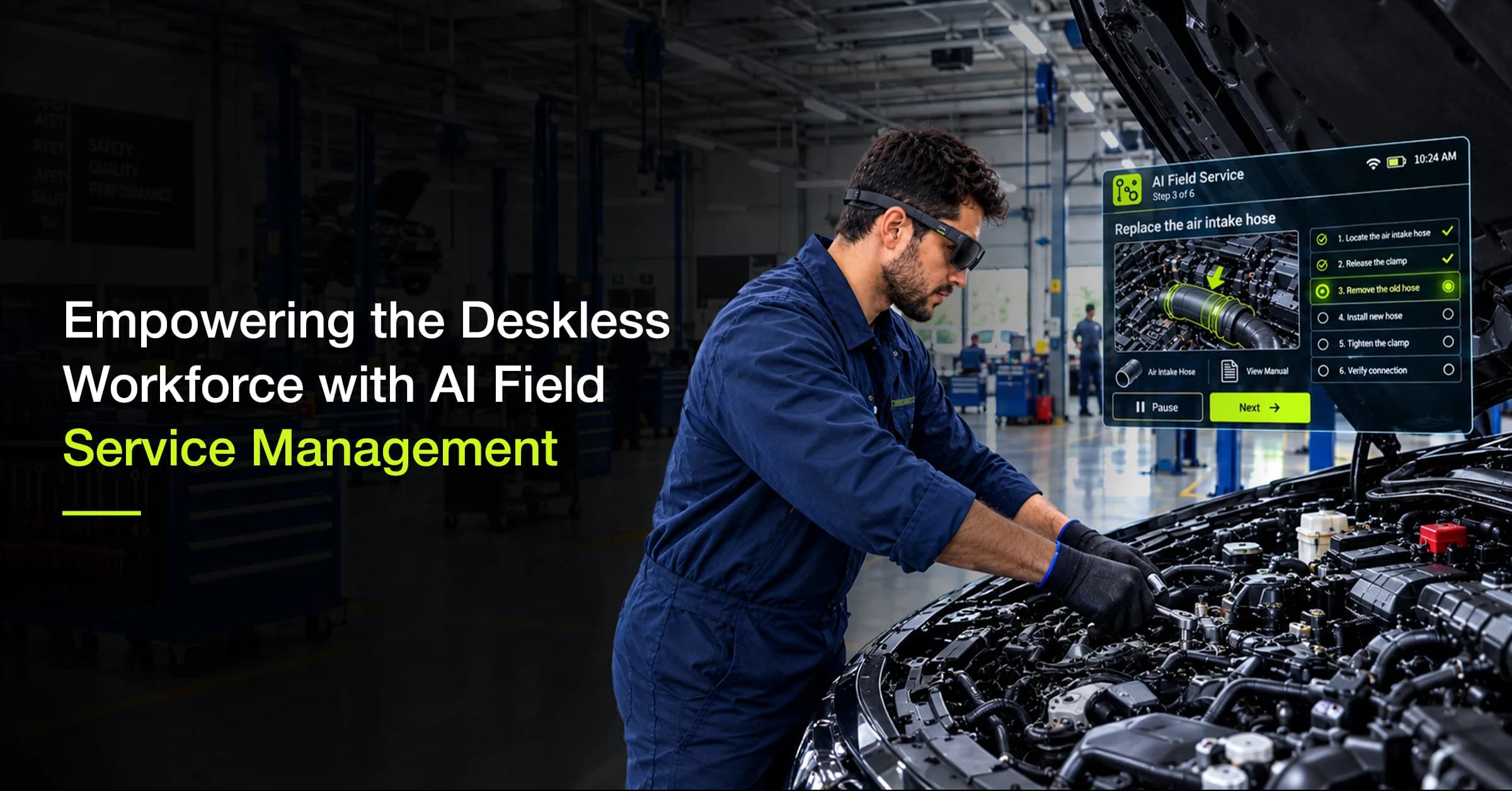
Instead of reading a sequence from a manual, the worker can receive step-by-step guidance while performing the task.
Instead of describing a problem to a remote expert, the expert can see the technician's field of view.
The combination creates a different interaction model:
This is particularly relevant for complex maintenance, inspection, assembly and field-service environments.
Deloitte has identified industrial AR applications across areas including manufacturing, aerospace and oil and gas, with applications spanning worker guidance, remote assistance and access to information during physical tasks.
The strategic opportunity isn't therefore “AR for AR's sake.”
It is using spatial interfaces to reduce the gap between digital intelligence and physical execution.
This is where the market is beginning to move beyond the conventional FSM category.
The evolution can be represented in three stages.
The system manages:
scheduling
dispatch
work orders
assets
inventory
service history
AI adds:
predictive insights
knowledge retrieval
diagnosis
recommendations
intelligent scheduling
anomaly detection
The system supports:
contextual guidance
AI-assisted execution
AR workflows
remote expertise
visual assistance
hands-free interaction
automated documentation
These aren't competing layers.
They are increasingly interconnected.
The FSM system knows what job needs to happen.
AI helps determine what is happening and what should happen next.
The connected-worker layer helps the technician actually execute it.
That is the architecture that makes AI meaningful for the deskless workforce.
There is a temptation in enterprise AI projects to measure success through technology adoption.
How many workers use the AI assistant?
How many queries were submitted?
How many workflows were created?
Those metrics are useful, but they don't prove business value.
Field-service organizations should instead connect AI initiatives to operational outcomes.
Can the technician resolve the issue during the first visit?
Does AI reduce the time between diagnosis and resolution?
How often does the technician need to involve a specialist?
Can scarce specialists support more field workers without physically travelling?
Can less-experienced workers become productive faster?
Does better diagnosis reduce unnecessary return trips?
Does automated documentation give technicians more time for actual service work?
Does the organization capture expertise from completed jobs and make it available for future ones?
This is a much more useful way to evaluate AI field service management.
The question isn't:
It is:
This is where the distinction between traditional FSM and a connected-worker platform becomes important.
UnfoldXR is built around the execution environment of the deskless worker.
Rather than replacing an organization's existing enterprise systems, the platform can sit closer to the point where physical work happens — connecting frontline workers with AI, workflows, enterprise knowledge, visual guidance and remote expertise.
The objective is straightforward:
UnfoldXR's platform brings together AI-powered assistance, guided workflows, AR experiences and connected-worker capabilities across devices including smartphones, tablets and smart glasses.
Its AVA agentic AI layer is designed to support the worker through the workflow rather than functioning simply as a conversational interface.
That distinction matters.
A chatbot primarily answers.
An execution-oriented AI needs to understand context, retrieve the relevant knowledge, guide the next action and help move the task toward completion.
That is the direction in which frontline AI is evolving.
Deskless workers are already surrounded by digital systems.
The problem is that many of those systems were designed around the enterprise rather than the worker.
The technician shouldn't have to think about which backend system contains the information they need.
The field engineer shouldn't need to stop the job to search through multiple documents.
The worker shouldn't need to become an expert in enterprise software to access operational expertise.
The technology should disappear into the workflow.
That means the future interface for field service may not always be a laptop, dashboard or mobile application.
It may be:
a voice interaction
a smart-glass display
an AR overlay
a contextual AI recommendation
a guided workflow
a visual diagnostic
an automated work-order update
The common denominator is proximity to the work.
The closer intelligence gets to the moment of execution, the more useful it becomes.
Field Service Management has already become good at optimizing resources.
The next frontier is optimizing human capability.
That means asking different questions.
Not simply:
How many jobs can we schedule today?
But:
How many jobs can our workforce resolve correctly?
Not simply:
How quickly can we dispatch a technician?
But:
How quickly can that technician reach a confident diagnosis?
Not simply:
How many technicians do we have?
But:
How much expertise can each technician access?
And not simply:
How much information do we have?
But:
That is the deeper promise of AI field service management.
The evolution of field service technology can ultimately be summarized in one shift:
Traditional FSM brought structure to field operations.
AI brings intelligence.
AR brings context.
Connected-worker platforms bring those capabilities together at the point of execution.
The result is not an autonomous field workforce.
It is something more practical — and potentially more valuable:
a workforce with greater access to expertise, better contextual awareness and less friction between decision and action.
For organizations operating complex field environments, that could be the difference between digitizing field service and genuinely transforming it.
The future of Field Service Management, therefore, may not be defined by how intelligently organizations can manage field workers.
It may be defined by how intelligently they can augment them.
And that is where the next productivity leap for the deskless workforce begins.