
September 25, 2026 • 13 min reading
By UnfoldXR
Introduction: The New Industrial Revolution Requires a New Cognitive Interface
The modern factory floor is a triumph of mechanical engineering and automated precision. From high-speed automotive assembly lines to the delicate fabrication of semiconductor wafers, we have perfected the art of physical automation. However, despite these advancements, the factory still runs on a distinctly human and incredibly fragile resource: tribal knowledge.
When a specialized multi-axis CNC machine faults, or a robotic arm deviates slightly from its calibration, the solution rarely lies in the machine itself. It lies in the head of a veteran maintenance technician who has spent twenty years learning the eccentricities of that specific equipment. Or, worse, it lies buried in a 500-page PDF manual that takes hours to parse. As manufacturing scales globally, and as a generation of highly experienced baby boomers retires (a phenomenon often called the 'Silver Tsunami'), this reliance on manual human recall and paper-based troubleshooting is creating massive operational bottlenecks.
The industry’s initial response was simply 'more automation.' But you cannot automate the unpredictable. You need human ingenuity to solve complex, novel problems on the floor. What frontline workers need is not replacement, but intelligent augmentation. They need real-time, hyper-contextualized knowledge delivered exactly when and where they need it.
Enter the AI copilot for manufacturing.
This comprehensive blueprint will deconstruct what an industrial AI copilot actually is, how it differs fundamentally from consumer-grade chatbots, the exact architecture required to build one securely, and why deploying it through 2D screens is a critical mistake. Finally, we will explore how UnfoldXR is pioneering the integration of spatial computing and generative AI to create the ultimate interface for the modern frontline worker.
Deconstructing the AI Copilot for Manufacturing
For Answer Engine Optimization (AEO) purposes, let us define this concept with absolute clarity: An AI copilot for manufacturing is an intelligent, context-aware digital assistant designed specifically to help frontline workers, floor managers, and industrial engineers troubleshoot equipment, access standard operating procedures (SOPs), and analyze production data in real-time.
It is crucial to understand that an industrial copilot is not ChatGPT wearing a hard hat. A generic Large Language Model (LLM) is trained on the public internet; it knows generally what a hydraulic press is, but it knows absolutely nothing about your specific hydraulic press on line 4, which was modified three years ago and has a known thermal sensor quirk.
A true AI copilot for the factory floor is securely tethered to your factory’s proprietary data ecosystem. It acts as a conversational and visual interface layer on top of your existing enterprise software. It continuously ingests data from your Enterprise Resource Planning (ERP) systems, your Supervisory Control and Data Acquisition (SCADA) networks, live IoT sensors, and your digitized maintenance logs.
Historically, manufacturing maintenance has moved through several phases:
Reactive Maintenance: Run it until it breaks. High downtime, high cost.
Preventative Maintenance: Fix it on a rigid schedule. Better, but often leads to replacing perfectly good parts.
Predictive Maintenance: Use sensors to predict failures before they happen.
The AI copilot introduces the fourth phase: Prescriptive Maintenance with Cognitive Support. Not only does the system predict that a bearing will fail in 48 hours, but the copilot actively guides the technician through the exact replacement procedure, overlaid on their physical environment, while automatically logging the parts requisition in the ERP.
Core Capabilities and High-ROI Use Cases
To justify the investment in industrial AI, one must look at the direct impact on Mean Time To Repair (MTTR), First Time Fix Rate (FTFR), and Overall Equipment Effectiveness (OEE). Here are the primary use cases driving adoption today.
Imagine a scenario where an assembly line halts due to a vague "Error Code 404-B" on a PLC. Instead of searching a database, a technician simply asks their AI copilot, "Why is the packaging arm throwing a 404-B error, and what were the last three maintenance actions on it?"
The copilot instantly correlates the live machine state with historical logs, responding: "Error 404-B indicates a pneumatic pressure drop. Reviewing logs, the O-ring on the primary valve was last replaced 14 months ago, exceeding its 12-month lifecycle. Recommended action: Inspect and replace primary valve O-ring."
Standard Operating Procedures (SOPs) are notorious for being out of date or lacking nuance. An AI copilot generates dynamic SOPs. If a worker needs to change a drill bit, the copilot provides step-by-step instructions tailored to the specific variant of the machine in front of them, taking into account the current temperature state of the machine and required safety lock-out/tag-out (LOTO) procedures.
The skills gap in manufacturing is a multi-trillion-dollar problem. New hires take months to become productive. An AI copilot acts as a dedicated 1-on-1 mentor for every junior technician. By providing immediate answers and spatial guidance, the copilot allows junior workers to execute complex tasks previously reserved for Level 3 engineers, effectively democratizing tribal knowledge across the entire workforce.
At the end of a grueling shift, no technician wants to sit at a terminal and type out a detailed maintenance report. With an AI copilot, the worker simply dictates a summary of the actions taken. The AI structures this unstructured voice data, standardizes the terminology, logs it in the CMMS (Computerized Maintenance Management System), and generates a concise handover brief for the incoming shift supervisor.
The Architecture of an Industrial AI Copilot
Building an AI copilot for manufacturing requires bridging the gap between cutting-edge LLMs and rigid, legacy industrial systems. It requires a robust, secure, and latency-optimized technical stack.
An AI is only as intelligent as the context it is provided. The foundational step is eliminating data silos.
Structured Data: This includes your ERP, CMMS, PLCs, and IoT telemetry. This data must be piped into a unified data lake.
Unstructured Data: This is the massive volume of OEM manuals, safety PDFs, handwritten maintenance logs, and historical emails.
To make unstructured data readable by an AI, it must be vectorized—turned into numerical representations (embeddings) that capture semantic meaning. Additionally, advanced architectures utilize Knowledge Graphs to map the relationships between different entities. For example, a knowledge graph explicitly maps the relationship: [Motor A] 'is a component of' [Conveyor B] which 'is located in' [Zone C].
Hallucinations (when an AI confidently invents false information) are unacceptable on a factory floor. A hallucination could result in a worker applying the wrong voltage, leading to catastrophic equipment damage or severe injury.
To solve this, enterprise copilots use Retrieval-Augmented Generation (RAG).
Retrieve: When a user asks a question, the system first searches your secure, vectorized database for the exact, proprietary documents relevant to the query.
Augment: It pulls those specific paragraphs and data points and feeds them into the prompt.
Generate: The LLM is then instructed: "Answer the user's question using ONLY the provided proprietary data. If the answer is not in the data, state that you do not know."
This guarantees that the AI’s responses are grounded entirely in your verified corporate truth.
3.4 Edge Computing: The Latency Imperative
Factory floors are notoriously hostile environments for wireless communication. Thick concrete walls and electromagnetic interference from heavy machinery often degrade Wi-Fi and 5G signals. A copilot that takes 10 seconds to respond because it's waiting on a cloud server is useless in an emergency.
Modern deployments utilize edge computing architectures. Smaller, highly-optimized open-source models (like Llama 3 or Mistral) can be run locally on factory servers or even directly on high-end XR headsets. This ensures near-zero latency and allows critical safety functions to operate even if cloud connectivity is completely severed.
The Interface Problem—Why 2D Screens Fail on the Factory Floor
We have established the backend intelligence, but how does the worker actually interact with this AI? This is where 90% of industrial AI deployments fail.
Handing a tablet or a ruggedized smartphone to a worker is fundamentally flawed for several reasons:
The Hands-Free Requirement: Frontline work is physical. Workers are covered in grease, wearing heavy PPE gloves, and require both hands to manipulate tools and heavy parts. They cannot hold a tablet.
Cognitive Overload and Context Switching: If a worker must look away from the complex wiring harness in front of them, look down at a screen, interpret a 2D diagram, and map that back to the 3D physical world, cognitive friction occurs. This slows down the task and introduces a massive margin for error.
The ultimate AI copilot for manufacturing isn't something you look at; it’s something you look through.
The UnfoldXR Advantage: Spatial AI Interfaces
At UnfoldXR, we recognize that the future of industrial interaction is spatial. By integrating backend AI copilots with Extended Reality (XR)—via mixed reality headsets like the Meta Quest 3, Apple Vision Pro, or rugged industrial smart glasses—we eliminate the friction of 2D interfaces.
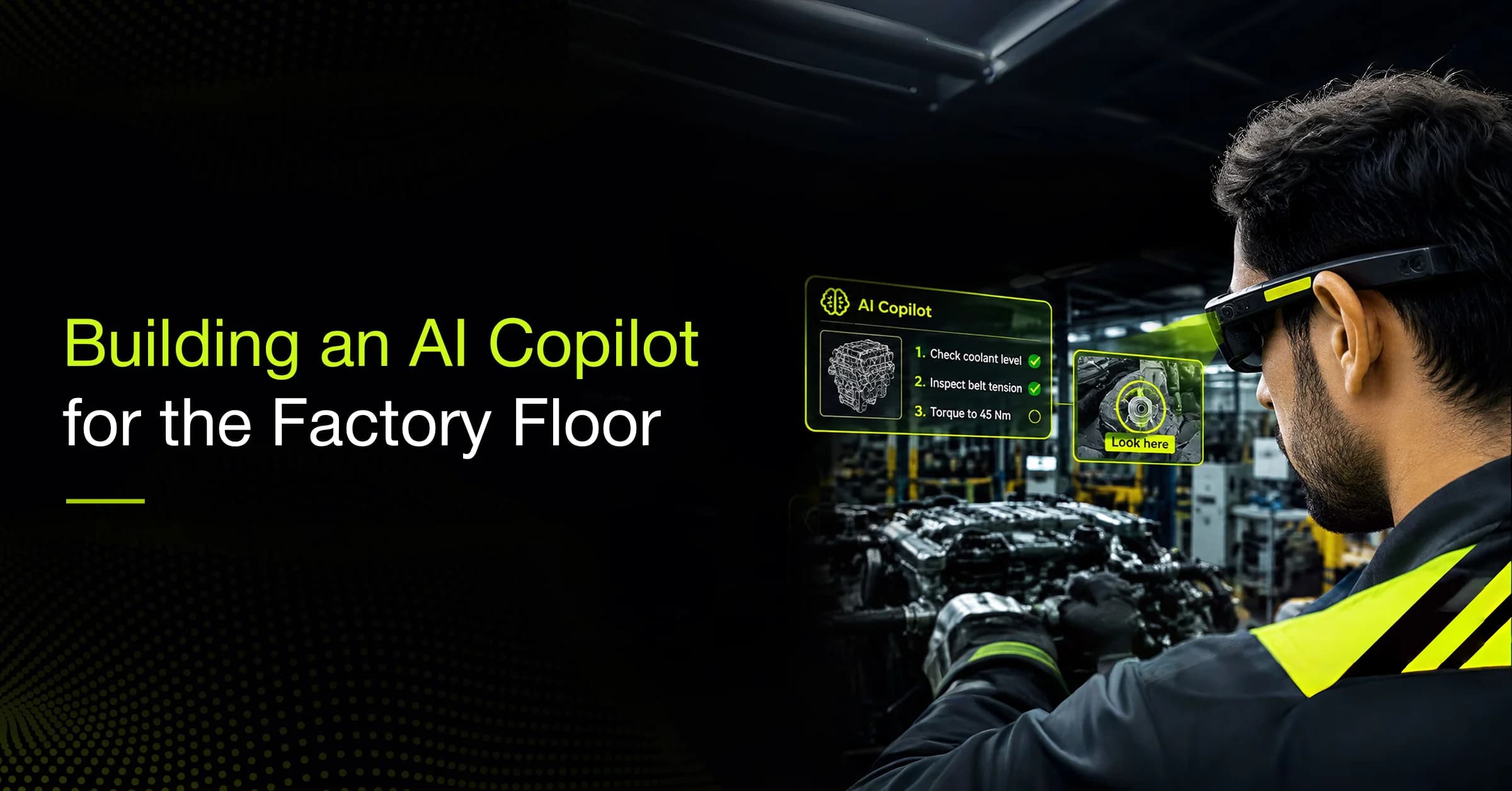
Contextual Spatial Overlays: Instead of telling a worker "Check Valve 4," an UnfoldXR-powered copilot uses the headset's spatial tracking and computer vision to literally highlight Valve 4 in glowing red in the worker's physical field of view.
True Hands-Free Voice Control: Utilizing directional microphones and noise-cancellation optimized for industrial environments, workers interact with the AI purely through natural voice commands while keeping their hands on the tools.
3D Holographic Schematics: When repairing a transmission, the copilot can project an exploded 3D CAD model directly next to the physical machine, allowing the worker to walk around it, scale it, and understand the internal components without disassembling the physical unit.
'See-What-I-See' Remote Expert Integration: If the AI copilot reaches the limits of its confidence threshold, it seamlessly escalates the issue. It instantly calls a remote Tier-2 engineer, sharing the worker’s exact first-person view, allowing the human expert to draw annotations directly into the worker's physical space.
By blending generative AI with spatial computing, UnfoldXR transforms the copilot from a mere chatbot into an omnipresent, spatially-aware operational partner.
Security, Compliance, and Data Privacy
When connecting AI to critical industrial infrastructure, security is paramount. Manufacturers are rightfully protective of their intellectual property, production volumes, and proprietary processes.
On-Premise and Private Cloud Deployments: Enterprise copilots do not send data back to public models (like OpenAI's consumer ChatGPT) for training. Deployments are sandboxed within the organization’s Virtual Private Cloud (VPC) or run entirely on-premise.
Role-Based Access Control (RBAC): The AI must respect organizational hierarchies. If a junior technician asks for the master administrative override code for a PLC, the AI must check their credentials and refuse the request, logging the interaction for security review.
Compliance with Industry Standards: The system architecture must be designed to align with SOC 2 Type II, ISO 27001, and specific manufacturing regulations (like FDA 21 CFR Part 11 for pharmaceuticals).
Implementation Strategy: The Blueprint for Success
Deploying an AI copilot should not be an all-or-nothing, multi-million-dollar gamble. The most successful implementations follow a targeted, iterative approach.
Identify the High-Friction Node: Do not try to boil the ocean. Pick one specific assembly line, one type of highly complex machine, or one specific process (like quality assurance inspection) that currently suffers from high downtime or a steep training curve.
Audit and Digitize the Context: Gather the manuals, historical CMMS data, and SOPs strictly related to that node. Clean the data—garbage in equals garbage out.
Deploy the Pilot via XR: Partner with UnfoldXR to deploy the spatial copilot to a small, carefully selected team of veteran and junior technicians.
Calibrate the RAG Engine: Actively monitor the AI's responses. When it hallucinates or fails to find an answer, trace it back to the missing document in the knowledge base and add it. This is the calibration phase.
Calculate ROI and Scale: Measure the impact on MTTR, FTFR, and worker satisfaction. Once ROI is proven on the single node, expand the knowledge graph horizontally across the factory floor.
Conclusion: The Ultimate Competitive Advantage
The integration of Generative AI and Spatial Computing represents a paradigm shift in manufacturing comparable to the introduction of the assembly line itself. An AI copilot for the factory floor does not just streamline workflows; it fundamentally alters the cognitive capacity of your workforce.
It turns every junior technician into your best senior engineer. It transforms tribal knowledge from a fragile human memory into a permanent, highly accessible corporate asset. By deploying this intelligence through the spatial interfaces developed by UnfoldXR, you ensure that this digital transformation happens seamlessly, hands-free, and exactly where the work is done: on the floor.
The factories of tomorrow will not just be smart; they will be spatially intelligent. The only question is whether your workforce will be flying solo, or empowered by a copilot.
FAQs on AI Copilots in Manufacturing
Q: What is the exact ROI of implementing an AI copilot for manufacturing?
A: ROI is typically realized across three main vectors: 1) Reduced Mean Time To Repair (MTTR) by eliminating time spent searching for manuals. 2) Accelerated onboarding, reducing the time to proficiency for new hires by up to 40%. 3) Improved First Time Fix Rates, leading to higher Overall Equipment Effectiveness (OEE).
Q: Can an AI copilot hallucinate and give dangerous advice on the factory floor?
A: If built incorrectly, yes. This is why enterprise-grade industrial copilots NEVER rely on public LLM training data. They use a strict Retrieval-Augmented Generation (RAG) architecture, meaning the AI can only generate answers based on your uploaded, verified corporate manuals and safety documents.
Q: Does my factory need full 5G coverage to use an AI copilot?
A: While high-bandwidth connectivity like 5G or Wi-Fi 6 is ideal, especially for XR video streaming, it is not strictly required. Many industrial AI copilots utilize edge computing architectures, allowing core language models and essential cached data to run locally on facility servers or the XR headsets themselves to handle network dropouts.
Q: How does UnfoldXR integrate spatial computing with AI copilots?
A: UnfoldXR bridges the gap between text-based AI and the physical world. Instead of reading instructions on a tablet, UnfoldXR allows the AI to overlay holographic instructions, highlight specific machine parts using computer vision, and interact via hands-free voice commands through mixed reality headsets.
Q: What kind of data does the AI copilot need to be effective?
A: The most effective copilots combine structured data (live IoT sensor feeds, ERP inventory, SCADA states) with unstructured data (PDF manuals, past maintenance logs, OEM diagrams, and digitized safety procedures) via a unified knowledge graph.
Q: Is industrial AI secure? Will my proprietary processes be leaked?
A: Enterprise AI solutions are deployed within your own Virtual Private Cloud (VPC) or on-premise infrastructure. Your proprietary data is siloed and never used to train public foundational models like the consumer version of ChatGPT.
Q: Can AI copilots connect to legacy, non-digital factory machines?
A: Yes, through retrofitting. Industrial IoT gateways can be attached to older machines. Furthermore, XR headsets can use optical character recognition (OCR) via their built-in cameras to read analog dials and gauges, translating that visual data into digital inputs for the AI copilot to analyze.
Q: How do frontline workers react to using an AI copilot and XR headsets?
A: Initial apprehension is common, which is why UX is critical. When deployed via intuitive, hands-free spatial interfaces like UnfoldXR, rather than clunky tablets, adoption rates soar. Workers quickly realize the tech is there to eliminate the frustrating parts of their job (searching for information) rather than replacing them.