
UnfoldXR · April 28, 2026 · 8 min read
For nearly two decades, extended reality has lived in that frustrating space of being “almost there.” Impressive in demos, exciting in gaming, but rarely useful enough for everyday work. Earlier augmented reality or extended reality depended on expensive, PC-tethered setups that were difficult to deploy and nearly impossible to scale. Even when the technology worked, it didn’t fit into real environments. It was heavy, isolated, and disconnected from how work actually happened.
That’s finally starting to change.
One of the biggest shifts has come from hardware. Standalone devices have removed the need for complex setups. You no longer need to be plugged into a powerful machine to access XR. This alone has made adoption far more practical.
At the same time, large technology players are investing heavily in this space. Meta continues to push its Quest ecosystem, Apple has entered with Vision Pro, and companies like Amazon are investing in smart glasses and wearable interfaces for logistics and industrial use cases. This level of investment signals long-term commitment to making XR viable at scale for larger masses.
Alongside high-end devices, there is a rise of lightweight, screenless, voice-first smart glasses designed specifically for frontline environments. These devices focus less on immersive visuals and more on usability. They are affordable, hands-free, and built for real work conditions making it a more practical entry point into XR for many industries.
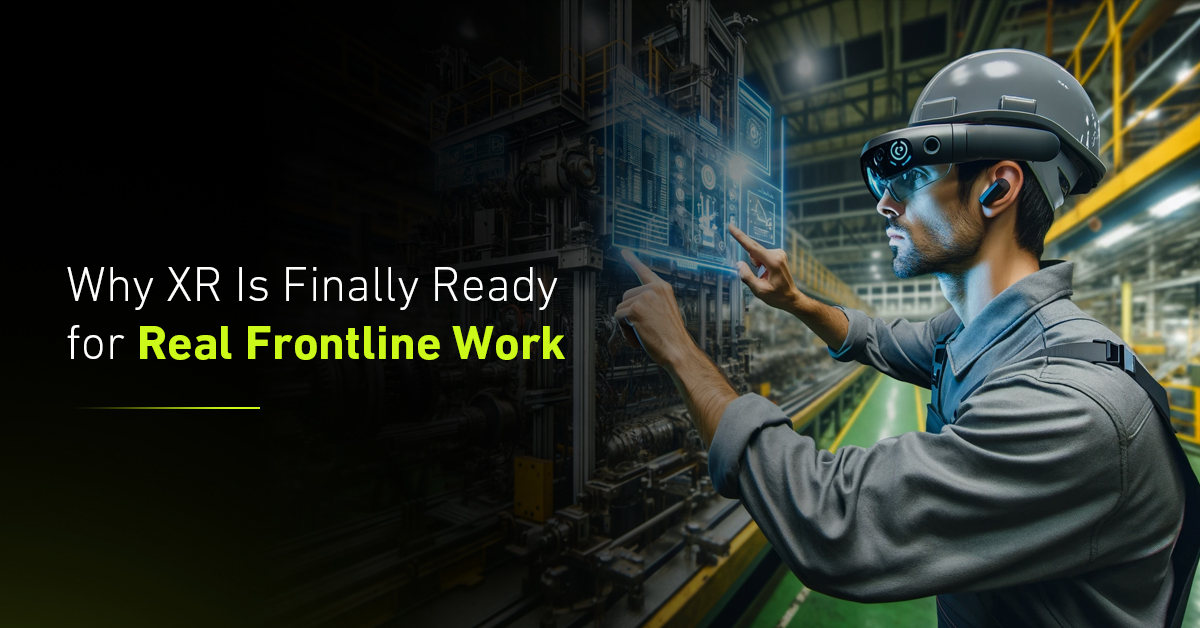
Earlier XR systems blocked out the real world, making them impractical for actual work. Now, mixed reality devices use cameras and sensors to understand the physical environment. They map surfaces, track movement, and recognise objects using markers like QR codes or visual cues.
This allows digital instructions to be placed directly onto real equipment. Arrows, highlights, and steps appear on the actual component being worked on and stay aligned as the user moves.
In most industrial use cases, this is not heavy 3D modelling but lightweight, real-time overlays on the physical world. Workers no longer switch between instructions and action. They see what to do, exactly where to do it, while doing it.
Even when hardware was available, creating XR content was a bottleneck. Building environments, workflows, or visual guides required specialised skills and significant time making it difficult to scale beyond pilots. Generative AI has revolutionised content creation across domains and XR is not left behind.
Workflows, SOPs, and guided instructions can now be created faster and updated continuously. Instead of building static experiences, organisations can create dynamic, evolving systems that reflect real operations. This change has been critical in adoption of XR as it is no longer limited by content.
Cloud computing and 5G are also playing an important role in making XR accessible. Heavy processing is moving off the device and into the cloud. This allows hardware to become lighter, more comfortable, and more affordable over time.
Combined with improvements in ergonomics, devices are now usable for longer durations. This is essential for frontline environments where comfort and safety matter as much as functionality. The barrier of cost is steadily reducing with mass adoption.
However, the most important shift has not been technical, but directional. XR is moving away from entertainment and into real work. Training, maintenance, inspections, and field service are becoming core use cases. These are environments where accuracy, speed, and consistency matter. XR is proving its value not by being immersive, but by being useful.
With XR starting to connect with enterprise systems, data is becoming actionable insight. Asset data, workflows, maintenance history, and operational insights are becoming part of the XR layer.
A technician is not just seeing instructions. They are accessing the right data, in context, at the moment of work. XR becomes part of the workflow, not an add-on.
With multiple global players investing in hardware, advancements in AI, and real integration with enterprise systems, XR is no longer waiting for adoption. It is reaching a point where it fits into how work actually happens.
The ecosystem for XR has grown stronger and, for the first time, the technology, the need, and the timing are aligned. The next phase of XR will not be defined by how immersive it is, but by how effectively it improves real work. UnfoldXR is built on this idea, aiming to make XR and AI useful in everyday frontline operations.
UnfoldXR brings structure to the ecosystem, combining AI and augmented reality to deliver guided workflows, real-time support, and seamless integration into existing systems. Whether it is training a new worker, guiding a repair, or enabling remote collaboration, the focus is on execution. It is not about creating immersive experiences. It is about helping frontline workers perform better at the moment of work.
To see how UnfoldXR brings XR into real operations, enabling faster training, smarter execution, and scalable workforce capability, request a demo.