
May 26, 2026 • 4 min reading
By UnfoldXR, Indrabati Sarkar / Lead - Brand Voice & Content (Consultant)
Every organisation already has their knowledge documented. It exists in the form of SOPs, manuals, maintenance records, training videos, dashboards, and experienced employees. Any mid-size organisation has more than 500 to 2000 active SOPs and for large enterprises this number can go up to 50,000 active SOPs as they manage complex, global workflows.
These knowledge documents or rich media like training videos contain deep operational understanding around inspections, repairs, troubleshooting, safety procedures, and machine behaviour etc. However, the challenge remains in making this knowledge usable during execution.
In most frontline environments, workers still spend a significant amount of time searching for information, switching between systems, calling supervisors, or depending on experienced colleagues for support. According to McKinsey, technicians spend up to 30% of their time looking for information instead of performing actual tasks.
This creates a gap between what organisations know and what workers can actually access at the moment of work.
Over the last couple of decades, many businesses digitised workflows. Paper forms became mobile apps, while checklists moved into software systems. Documentation became easier to manage but most workflows are still passive.
They record work after it happens instead of guiding workers while work is happening. Frontline teams are still expected to:
Interpret SOPs manually
Navigate multiple disconnected systems
Remember procedures from training
Escalate issues through calls or messaging
As operations scale, this becomes difficult to manage consistently. Knowledge remains fragmented across systems and individuals instead of becoming operationally accessible.
IBM’s recent research on AI workflows points to a larger industry shift where organisations are moving beyond automation toward systems that can coordinate, support, and improve execution in real time. The IBM Institute for Business Value found that 82% of operations executives expect process automation and workflow reinvention to become more effective because of AI agents by 2027.
This is where guided workflows become important.
Guided workflows turn operational knowledge into real-time execution support. Instead of asking workers to search for information and interpret instructions independently, systems guide them step by step during tasks. Instructions become contextual to the specific asset, environment, and workflow being executed.
While troubleshooting an equipment, a technician can instantly access:
Asset history
Relevant SOPs
Previous faults and fixes
Contextual diagnostics
Remote expert support if needed
The workflow adapts to the situation instead of remaining a static checklist.
For frontline workers, the knowledge support goes from ‘read and remember’ to ‘guide and execute.’
Organisations are increasingly realising that AI creates value not just through automation, but through better workflows. Research from McKinsey shows that high-performing companies are using AI to redesign how work gets done and scale operations faster. As a result, AI-powered and agent-driven workflows are becoming critical for improving operational efficiency and execution across industries.
This is where platforms like UnfoldXR are changing frontline operations. With its Agentic AI, AVA, UnfoldXR is bringing the organisational knowledge to the shop floor and making it operational at the moment of work.
Workers receive:
Intelligent task allocation
Access to asset history and workflows
Readiness guidance before execution begins
Teams are supported through:
Step-by-step contextual guidance
Real-time diagnostics and recommendations
Smart Scan for instant workflow access
Remote collaboration with experts
The system automatically captures:
Reports and documentation
Photos, videos, and operational notes
Performance insights and workflow improvements
Knowledge no longer stays trapped in systems or individuals. It becomes continuously reusable and operational.
Guided workflows create the strongest impact in environments where consistency and speed directly affect operations. These environments are dynamic. Workers often operate under time pressure while handling complex assets, changing conditions, and varying skill levels. Real-time support reduces dependency on tribal knowledge and improves execution consistency across locations and teams.
Use cases where guided workflow creates major impact:
Maintenance and repair
Inspection and compliance
Field service operations
Troubleshooting and diagnostics
Training and onboarding
Quality assurance workflows
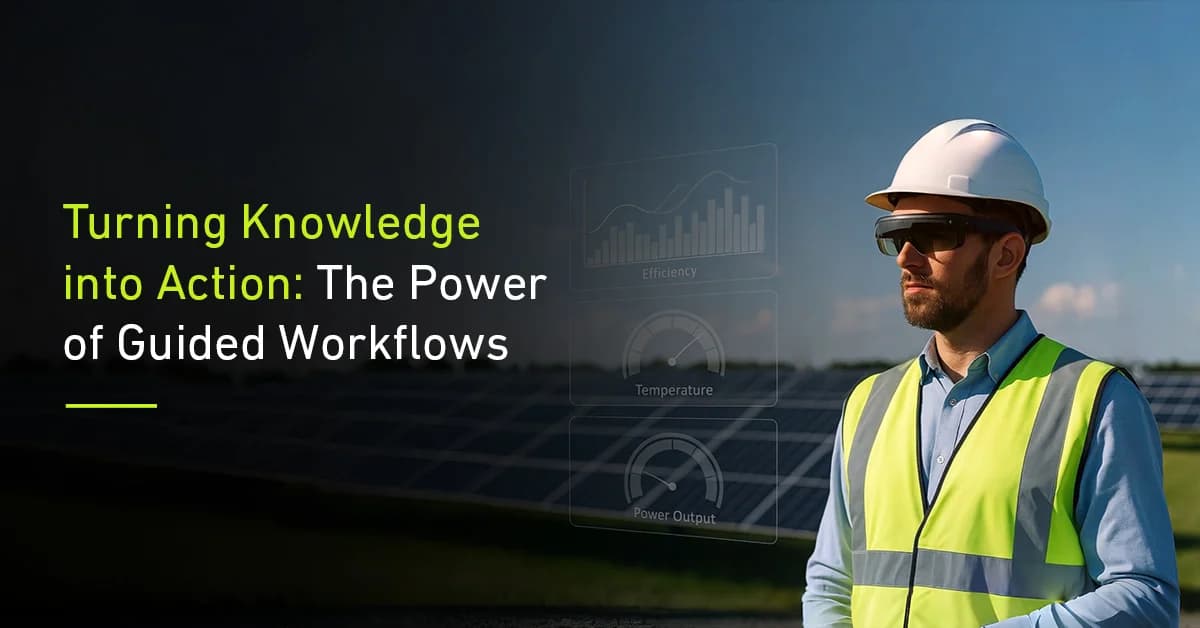
Augmented reality adds another layer to guided workflows by bringing instructions directly into the physical environment.
Instead of referring to separate manuals or screens, workers can see contextual guidance aligned to the exact machine or component they are working on. This reduces interpretation errors and improves focus during execution. AR also improves remote collaboration. Experts can guide workers visually in real time rather than relying only on verbal instructions.
Guided Workflow helps organisations:
Reduce downtime and rework
Improve first-time fix rates
Accelerate onboarding
Standardise execution across teams
Reduce dependency on experienced personnel
Continuously capture operational knowledge
The next phase of operational excellence will not be defined by how much information organisations collect. It will depend on how effectively they turn knowledge into action.
To know more about how UnfoldXR is enabling operational excellence by augmenting human performance through AI-powered Guided Workflows, write to us at info@unflodxr.com or visit us at www.unfoldxr.com.