
June 09, 2026 • 3 min reading
By Indrabati Sarkar, Lead - Brand Voice & Content (Consultant)
‘AI is like electricity. Just as electricity transformed every major industry a century ago, AI is now poised to do the same.” Andrew Ng, Computer Scientist & Co-Founder of Google Brain, Coursera, Landing.AI, DeepLearning.AI.
And that transformation is already beginning on the frontline.
A recent study by Politecnico di Milano and Amazon found that 80% of companies using AI in logistics reassigned workers to higher value-added roles, while 85% reported improvements in efficiency and customer satisfaction. Instead of cutting jobs, technology is helping workers transition from repetitive tasks to roles that require decision-making, problem-solving, and technical skills.
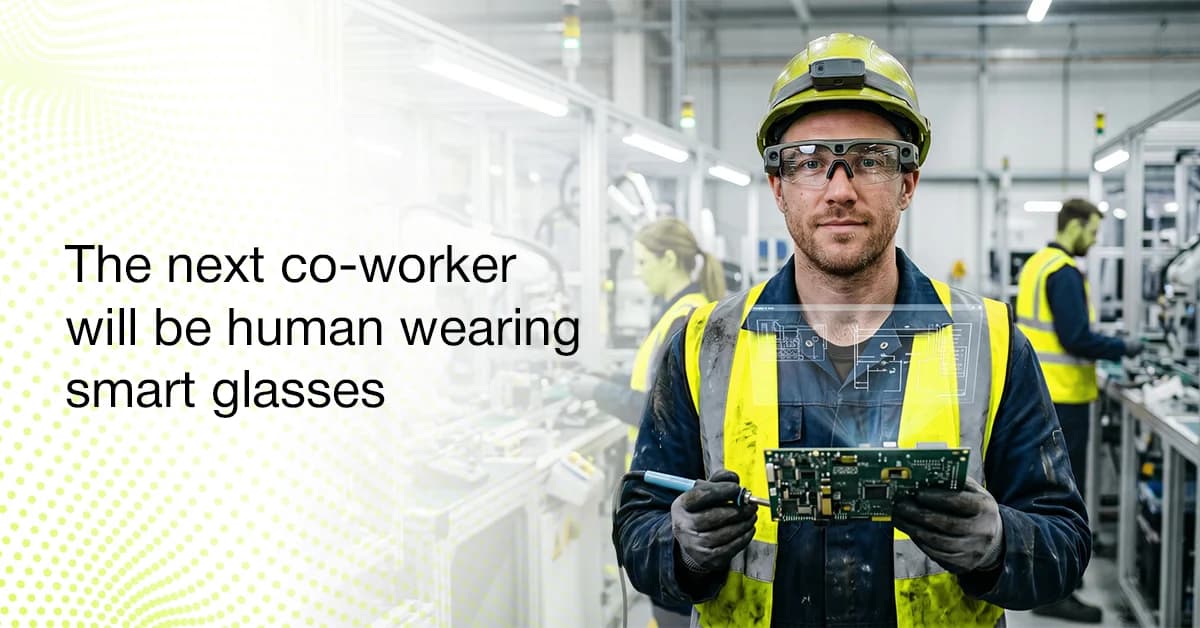
From warehouses using wearable scanners for quicker inventory movement to technicians getting remote help during repairs, wearable technology is changing how work gets done. The next stage in this evolution is wearable augmented reality, where workers receive real-time information right in their line of sight while they perform tasks and the need for this change is growing.
Even with increasing digitization, frontline work still relies heavily on:
* Manuals and SOPs
* Human memory
* Delayed expert support
* Switching between disconnected systems
According to McKinsey, technicians spend up to 30% of their time searching for information rather than doing actual work. Smart glasses and AR-powered workflows are starting to lessen that problem.
In simple terms, augmented reality overlays digital information onto the physical environment instead of completely replacing it like VR.
For frontline jobs, this means workers can access:
* Step-by-step workflows
* Asset history and diagnostics
* Visual guidance during repairs
* Real-time remote support
* Inspection and compliance checklists
The information appears in context while the worker is doing their job.
A technician fixing equipment can get guided instructions without stopping to check a laptop or manual. Warehouse workers can follow picking workflows hands-free. In healthcare settings, wearable AR can assist with guided procedures and remote help during critical operations.
This is where the augmented reality workflow becomes practically useful. Guidance and execution are no longer separate; they become part of the job itself.
For years, enterprise AR faced challenges with bulky hardware, short battery life, and complex deployment. Most people still linked AR to gaming or experimental technology.
But now, hardware is becoming:
* Lighter
* More ergonomic
* Better suited for long-term use
* Easier to incorporate into enterprise systems
According to ABI Research, shipments of enterprise smart glasses are expected to exceed 20 million units a year by 2030 as adoption picks up across industrial sectors.
At the same time, AI is making these systems more intelligent and context-aware.
Instead of just showing information, AI can now adjust workflows based on the task, worker inputs, and operational conditions. Workers can connect instantly with remote experts, access diagnostics through Smart Scan systems, and get support while they work.
Most people first encountered AR through filters, gaming, or augmented reality in retail, where users could try products virtually before they buy. Now, enterprise adoption is getting much more serious.
Industries are using AR to:
* Reduce downtime
* Speed up onboarding
* Improve first-time fix rates
* Standardize execution across teams
* Decrease reliance on tribal knowledge
The value of AR is no longer just in visualization but in operational execution.
The Amazon study found that companies using AI not only improved efficiency but also created new operational roles and enhanced workforce skills. In fact, 40% of surveyed companies reported increased employee digital skills after implementing AI systems.
That seems to be the direction we’re heading. Not workers versus technology. Workers supported by technology.
The next co-worker may not be a robot alongside a human. It might simply be real-time intelligence provided through what workers wear.
To know more about how you can use AI & AR technology to improve frontline efficiency visit www.unfoldxr.com or write to us at info@unfoldxr.com.