
June 02, 2026 • 4 min reading
By Indrabati Sarkar, Indrabati Sarkar / Lead - Brand Voice & Content (Consultant)
While we don’t notice it, for most of us, augmented reality has already quietly entered everyday life.
Trying on sunglasses through a phone camera, testing how furniture looks in a room, using face filters on social media, or previewing outfits digitally are all familiar examples of augmented reality in action. Industries like augmented reality in retail and augmented reality real estate have already shown how digital information can enhance real-world experiences in practical ways.
But AR is now moving into something much bigger than consumer experiences and gaming. It is becoming a serious operational tool for businesses across industries.
In simple terms, augmented reality adds digital information into the physical environment instead of replacing it entirely like virtual reality does.
That information could include:
Instructions
Visual overlays
Diagnostics
Annotations
Alerts or workflows
What we have to understand is that AR is not just about visual overlays; it has a defined goal of helping people make better decisions while performing a task. It is aimed at creating higher efficiency and building greater confidence for the user. The use case of AR in enterprises is increasingly becoming important for frontline industries where workers often depend on manuals, memory, and delayed expert support during operations.
For years, enterprise AR struggled because hardware was expensive, bulky, and difficult to deploy at scale. But several developments are making wearable augmented reality and mobile AR far more practical:
Lighter and more ergonomic smart devices
Better mobile and tablet-based AR experiences
Improvements in AI and computer vision
Faster cloud computing and connectivity
Easier integration with enterprise systems and workflows
AR is no longer limited to specialised headsets alone. Many operational workflows can now run through phones, tablets, and lightweight wearables depending on the use case. At the same time, industries are facing growing pressure to improve productivity, reduce downtime, and address skilled workforce shortages where AR becomes operationally valuable.
Frontline work is highly dependent on execution quality and heavily time bound. Technicians, inspectors, and field workers often lose time searching for information, escalating issues, or interpreting static instructions. According to McKinsey, technicians spend up to 30% of their time searching for information instead of performing actual work.
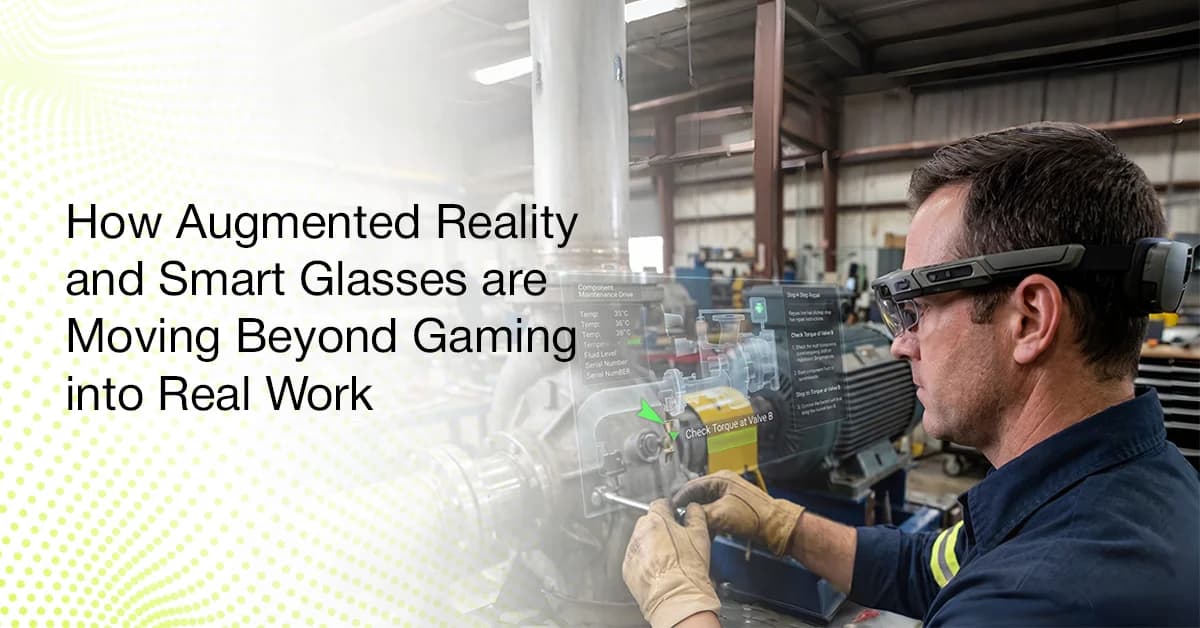
AR changes this by bringing guidance directly into the flow of work. Instead of switching between systems or reading lengthy manuals, workers can receive contextual support while performing tasks:
Step-by-step instructions
Visual guidance aligned to equipment
Real-time diagnostics
Remote video support from experts
Contextual information based on the task or asset
This improves clarity during execution and reduces dependency on a handful of skilled workers. Importantly, AR is not just about visualisation, its real value lies in operational guidance.
AR systems use cameras and sensors to understand the surrounding environment and place digital information within the worker’s field of view.
A worker scanning a machine, for example, can instantly access:
Maintenance history
Inspection workflows
Troubleshooting guidance
Previous fault records
The information appears in context, making it easier to act quickly and accurately.
When combined with AI and an augmented reality workflow, the experience becomes even more powerful. Systems can adapt guidance dynamically based on the task, worker inputs, or operational conditions.
The operational benefits are becoming increasingly measurable:
Faster onboarding and training
Reduced downtime and rework
Better first-time fix rates
Improved compliance and documentation
Greater consistency across teams and locations
Studies by PTC and Deloitte show that guided workflows can reduce task completion time by 30–50%.
At the same time, 80% of manufacturers say AI is helping improve productivity and save time, according to KPMG.
At UnfoldXR, the focus is not just on AR as a visual layer, but on combining AR with AI-powered guided workflows that actively support execution right at the frontline.
This includes:
Real-time contextual guidance
Smart Scan and asset recognition
AI-assisted workflows
Remote expert collaboration
Continuous knowledge capture before, during, and after work
At UnfoldXR, our goal is to augment human capabilities and bring intelligence directly into the moment of work with latest technologies like AI, AR, VR, MR and more. To know more about what we are doing to make enterprise AR accessible and cost-effective write to us at info@unfoldxr.com or visit www.unfoldxr.com.