
June 22, 2026 • 4 min reading
By Indrabati Sarkar, Lead - Brand Voice & Content (Consultant)
Speed and adaptability are the two defining advantages of businesses today. According to Deloitte’s 2026 Global Human Capital Trends report, 7 in 10 business leaders identify speed and agility as their primary competitive strategy for the next three years. Leaders also point to two key drivers of success - accelerating how people and resources are orchestrated to perform work, and increasing the workforce’s ability to adapt to change.
Yet in many frontline industries, despite all the technological advancement, uncertainty during execution remains to the biggest barrier to speed.
From a maintenance technician troubleshooting an unfamiliar issue, to an inspector waiting for expert validation and a field engineer trying to access the latest information while at work - are all examples of moments of uncertainty that are happening thousands of times every day across manufacturing plants, warehouses, healthcare facilities, utilities, and field operations. And all these situations lead to unplanned downtime that is costing industrial businesses up to $50 billion annually, according to Deloitte.
Every industry environment is unpredictable and dynamic because of which decisions at the frontline have to be made in real time in a number of situations.
This results in workers constantly dealing with:
Incomplete information
Multiple disconnected systems
Changing operational conditions
Delayed access to expertise
Knowledge locked within experienced employees
In environments such as these uncertainty becomes operational friction, increasing response time, affecting execution quality and placing a significant cognitive burden on workers.
With all the tech and data, frontline employees are not getting the support they need at the moment of decision making. According to McKinsey, technicians are spending up to 30% of their time searching for information instead of performing actual work. Furthermore, ineffective labor utilization result in "payroll leakage" of 0.5% to 2.5% of total annual payroll, with employee turnover for skilled positions costing up to $40,000 per worker (Deloitte)
Largely, AI has been a office set-up technology to be used in dashboards, reports, and analytics platforms, helping organisations analyse the data collected through multiple systems,
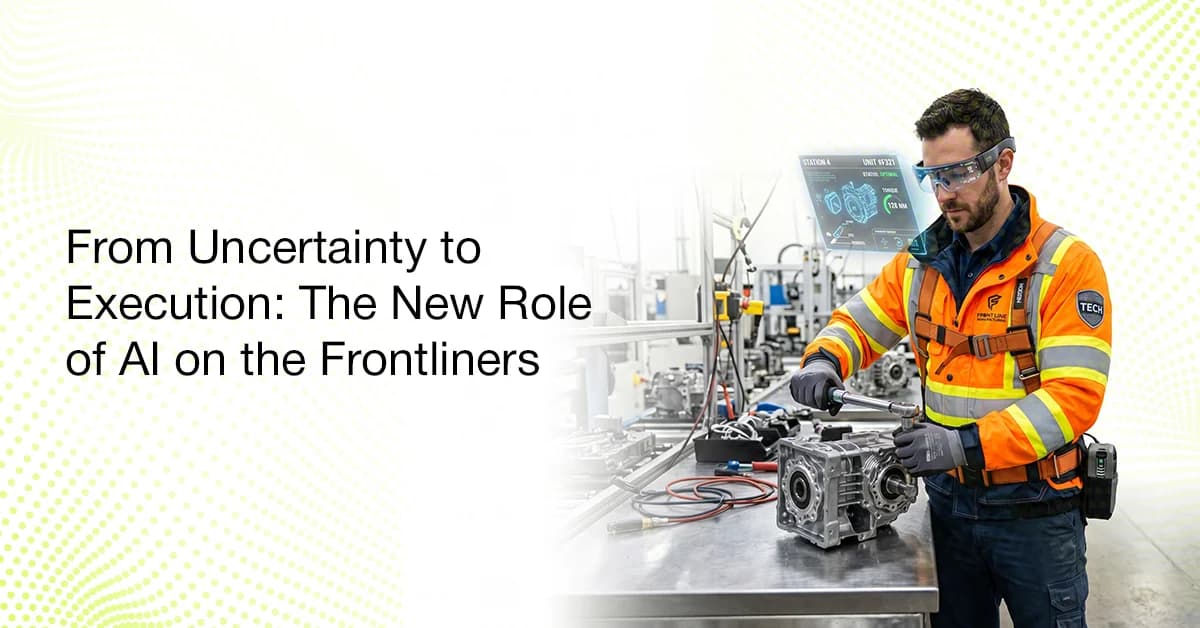
But today AI has to reach the point of action, where the work in happening in real time to actually make a difference. With Agentic AI providing support, teams can get recommendations based on the asset, environment, and workflow in front of them.
The frontline is going to receive the actual support that they need to perform their tasks with confidence and greater efficiency.
It is only when workers have access to the right information at the moment of work, decisions become faster and more consistent and beneficial to the organisation.
Real-time guidance can help workers:
Access relevant knowledge instantly
Follow contextual workflows
Reduce dependency on memory
Escalate issues more effectively
Make informed decisions with greater confidence
This becomes especially important as industries face growing skill shortages and workforce transitions. Even workers with less experience, can perform complex tasks more consistently when supported during execution. Expert knowledge becomes easier to capture, share, and scale across teams. Training no longer happens only during onboarding but is embedded in the flow of work, as a continuous process.
With workers at the centre of AI deployment, companies can leverage the human-machine combination which is set to bring more value to any organisation rather than the ones treating AI as tech upgrade only.
Maintenance, inspections, healthcare, and field operations all require something technology alone cannot replicate - human judgement.
Workers interpret context, adapt to changing conditions and make decisions when procedures do not match reality.
AI can provide recommendations, surface relevant information, and reduce ambiguity but it cannot replace the experience required to navigate complex situations.
This is where platforms like UnfoldXR are creating a new model for frontline operations with the aim to augment human capabilities by reducing uncertainty and increasing productivity.
At the centre of this approach is AVA, UnfoldXR’s agentic AI layer that supports workers before, during, and after execution. From providing contextual information and real-time guidance to capturing knowledge automatically, AVA helps reduce dependency on manuals, memory, and delayed expert support.
Built to be device-agnostic, UnfoldXR works across smartphones, tablets, wearables, and smart glasses, bringing intelligence directly into the moment of work. To know more about our solutions visit www.unfoldxr.com or write to us info@unfoldxr.com