
UnfoldXR · April 21, 2026 · 8 min read
The workforce challenge is no longer emerging. It is already here. The 2026 Talent Shortage Survey suggests that employers across 41 countries reveal 72% report difficulty filling roles. Across industries, experienced workers are retiring while new hires enter with limited hands-on exposure. According to the World Economic Forum, over 50% of all employees will require reskilling in the coming years. At the same time, sectors like manufacturing, automation and field service continue to face a shortage of skilled technicians.
This creates a critical gap. The demand for expertise is growing, but the availability of experienced professionals is not keeping pace.
Most organizations still rely on outdated methods of knowledge transfer. Shadowing senior workers, classroom training, and static manuals continue to dominate onboarding and skill development, which are slow and inconsistent processes.
In this way, knowledge often remains tied to individuals rather than becoming accessible to all. When an experienced worker is unavailable, the ability to execute complex tasks drops. Even when knowledge is documented, it is rarely accessible at the moment of work. The result is a workforce that is trained, but not always prepared.
When expertise is not available in real time, the impact is immediate. Tasks take longer to complete. Errors increase. Escalations become frequent. In field service environments, this often leads to repeat visits and unresolved issues. Unplanned downtime increases as problems take longer to diagnose and fix. Travel costs rise as experts are required on-site for issues that could have been resolved remotely.
In this age and time, agility is a critical function for businesses, it is non-negotiable to bring expertise where it is required, right when it is required.
Remote collaboration is well established for desk-based roles. Video calls, screen sharing, and real-time communication tools are part of everyday workflows.
The 80% of workforce, which is in the frontline has not had the same advantage. Work happens in physical environments where context matters. A phone call cannot show what a technician is seeing. Static instructions fail to adapt to real-time conditions, and as a result, frontline workers continue to rely on fragmented support systems.
Augmented reality changes how remote support works in physical environments.
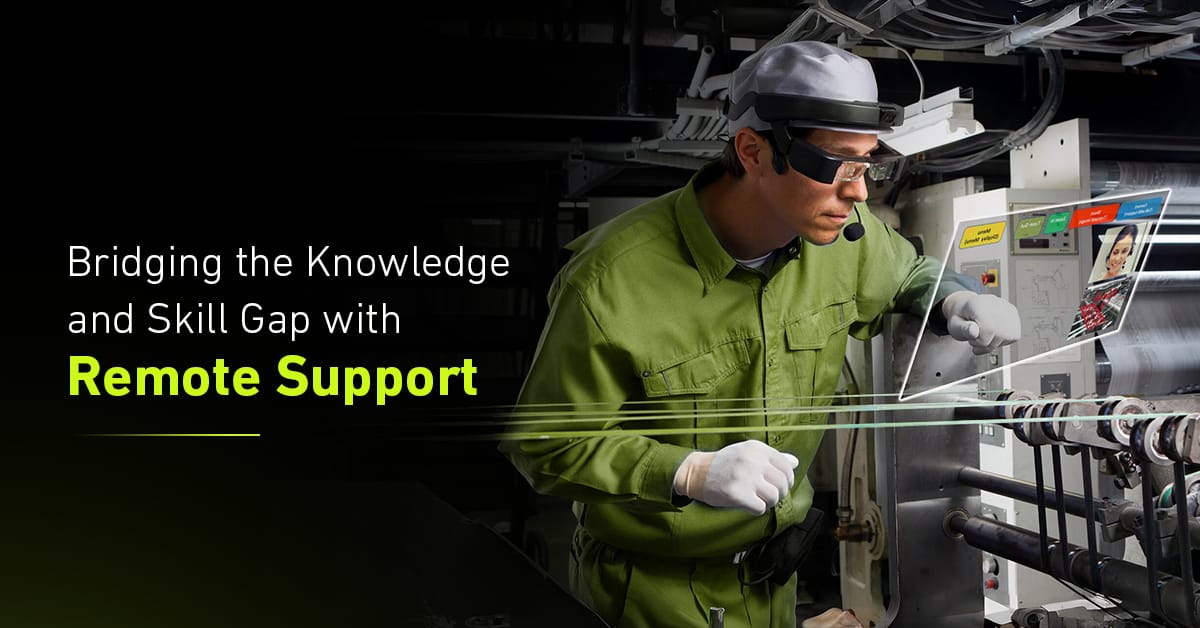
Instead of explaining issues verbally, experts can see exactly what the worker sees and guide them visually. Instructions become contextual, aligned to the asset, the task, and the situation.
At the same time, hardware is becoming more practical for real-world deployment. Smart glasses and wearable devices are now lighter, more ergonomic, and increasingly affordable, making it easier to scale AR-enabled support across frontline teams.
A technician troubleshooting a machine can receive step-by-step visual guidance in real time. This removes ambiguity and reduces the chances of misinterpretation.
The traditional model relies on escalation. When a worker faces an issue, the next step is to call an expert which creates delays and dependencies.
With AR-enabled remote support, expertise becomes embedded within the workflow. Guidance is available at the moment of need, without waiting for availability or travel. A worker does not have to stop and seek help. The help becomes part of how the task is completed.
One of the most overlooked opportunities in remote support is knowledge capture. Every resolved issue, every guided session, and every expert interaction contains valuable insights. Traditionally, this knowledge is lost once the task is completed.
With the right system, these interactions can be captured and converted into reusable workflows. A remote support session that solves a complex issue today can become a guided process for future use. Over time, this builds a scalable knowledge base that reduces dependency on individual experts.
UnfoldXR brings AI and augmented reality together to improve frontline productivity at the moment of work. It addresses the growing skill gap by augmenting human capability with real-time guidance, contextual support, and seamless access to expertise. Instead of relying on availability of experts or traditional training cycles, frontline teams are enabled to perform tasks with clarity and confidence as they work.
By embedding remote support directly into workflows, UnfoldXR ensures that knowledge is made available to the worker, enhancing their performance and reducing errors significantly. What was once dependent on escalation and availability becomes accessible on demand, turning expertise into a scalable, always-available layer within operations.
This shift delivers measurable business impact:
Faster issue resolution
Reduced need for expert travel
Higher first-time fix rates
Lower operational costs
Improved workforce productivity
Organizations are able to scale expertise without scaling headcount, moving from a model of dependency to one of capability. See how UnfoldXR enables faster resolution, better execution, and scalable workforce capability. Request a demo.